

Why Discipline Fails, and Structure Wins
Did you know that in order to be considered a “shooter” on a Division 1 school basketball team, you have to shoot nearly 80% efficiency in practice? The consideration is that if you can shoot at 70-90% in practice, that will translate to 35-50% in real game situations. The stress and pressure and contest the game adds cuts your shooting percentage straight in half. When you look at the final performance, impressive as it is, it’s still never even close to what can happen in practice.
Trading is no different than other high stress situations. There is what a trader can do in a simulation, in practice, when markets are calm. Then there is the real world when money is on the line and volatility is spiking.
Traders tend to have a habit of making rules for themselves in two situations. The first, when things are really calm, and they think the rules are relatively simple to follow with a little discipline. The second, when things are really bad, they’ve had a poor run and they want to discipline their way out of it.
But when you look closely at both these situations, you’ll see they both come down to a reliance on discipline, when in reality, the rules were never really designed to survive the stress of the real world situation.
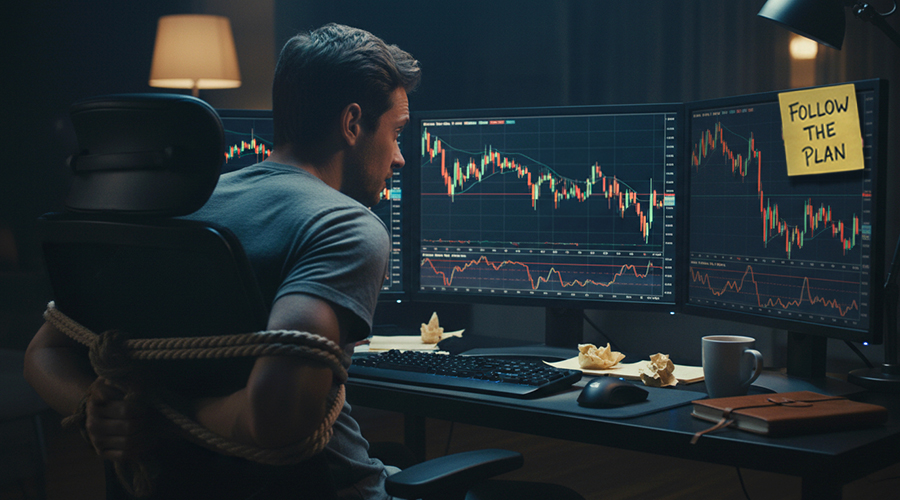
1. The Rule is Too Vague
The first kind of rule, when things are calm, usually falls into the category of “too vague”.
The rule could be something like “Don’t chase tickers”.
But what does that mean at 9:32am when the volume is exploding? What does it mean on a trend day? What does it mean on a penny stock vs a large cap beta stock? What does that show up like in a real contested, high stress situation? Your brain can wiggle out of anything vague.
A better rule is a defined one. “I only enter after a higher low on the timeframe I’m trading, and I never hit the buy button on a candle more than 1ATR extended from the EMA12.” Clear, measurable, harder to cheat.
2. The Rule Fights Emotion Instead of Channeling It
These rules are usually derived after we’ve hit a draw down, because they’re the rules that remind us of all the things we did wrong. How we never want to act again. “No revenge trading, no adding to losers, no trading pre-market”. But rules that are written from fear are the first ones to go when fear shows back up. Because they are still habits, bad ones. Professionals design rules that absorb emotions, not fight them. A coach calls a timeout quickly when the other team scores a few too many points in a row.

If frustrations spike, a professional trader’s system forces a break, perhaps their next trade can’t be placed until they fill out a checklist. Perhaps their platform won’t let them place an order without defining risk, or they tier their sizing. They don’t “stay disciplined", they design the process that stays disciplined for them.
3. The Rule Depends on Willpower, Not Structure
This is where all the practice comes in. The 80%+ efficiency that is needed to shoot only 40% in games. Shooters know that in games, 40% is considered good, 50+% is considered great. Traders know this too. They never expect to win 100% of the time. In fact, they know that 60% is considered well above average. That means that nearly half the time, you are losing. And that means that ALL of the time, you need a system in place that expects you to lose.
Bad Rule: “Use a stop Loss”. Because the reality is, you’ll move the stop loss the moment it gets close, or re-enter because you want to get back the trade.
Pros remove the option. They rely on the statistics, not on each individual trade.
Their stop goes in immediately. Their size is predefined. Their first partial is planned. Their max loss is mechanical. Their account might even have a breaker that shuts them out for the day after a certain sized loss. It’s not willpower, it’s architecture. If your rules rely on you being in a constant strong headspace, they’re going to fail.
Design them for the version of you who is tired, annoyed, excited, scared, or under pressure. Because that’s the reality of trading.
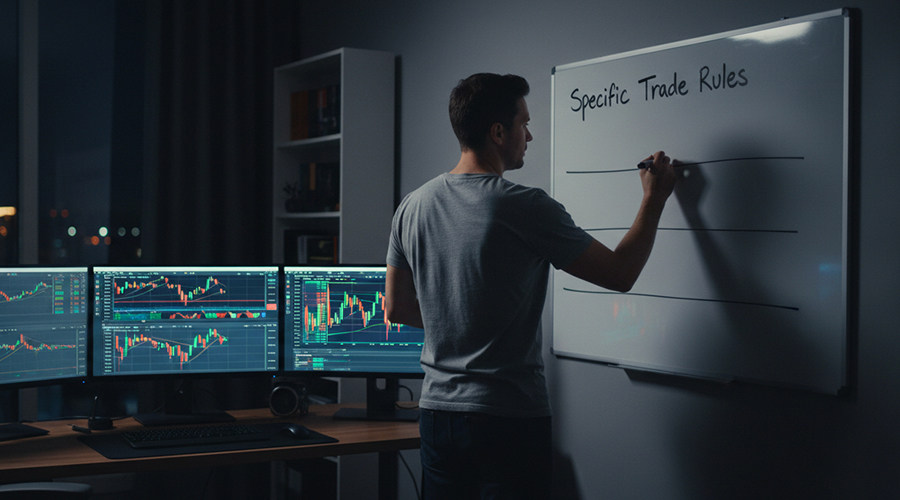
A Sample Trading Plan Worth Following:
Trade Selection:
I only trade:
- names showing clear relative strength or weakness to QQQ
- confirmed setups from my A or B playbooks
- timeframes 5-minute and higher unless volatility demands lower
I do not trade:
- premarket
- chop with no trend
- extended 1-minute candles
- anything outside my playbook list
Risk Framework
- 1R per trade (*R = your risk variable)
- 4R max loss per day
- first partial always at 1–1.5R
- stop is placed immediately
- stop is never moved further away
If I break any rule, I’m done for the day.
Entry Checklist
- Before entering, at least 3/4 must be true:
- Trend on the higher timeframe supports the trade
- Break of structure or confirmation candle is printed
- Relative strength/weakness agrees
- Volume supports the move
I cannot place an order until this checklist is ticked off.
Emotional Safeguards
- If I miss the trade, I do not chase. I wait for the next HL/LH.
- After two losses in a row, I must take a 5-minute break.
- After a big win, I reset — I do not assume momentum carries into the next trade.
- If I feel tilt, hesitation, or frustration, I step away for water or a walk.
Trade Management
- Size tiers planned ahead
- Add only on strength, not weakness
- Lower timeframe noise does not override higher timeframe structure
- Exit if the 15m trend breaks (for trend days)
Daily Review
The day is graded on execution, not PnL.
- Did I follow rules?
- Did I stick to size?
- Did I avoid C-grade setups?
- Did emotion affect decisions?
A win with bad execution = bad day.
A loss with clean execution = great day.
Every trader has a moment where they stare at a red trade and think, “Why did I do that? I knew better.”
But that moment isn’t failure, it’s exposure.
It shows you the exact point where your system needs reinforcement.
And if you fix the structure around that moment, you don’t need more discipline.
Rules alone won’t save you.
Good design will.
