


Feeling overwhelmed with indicators, signals, too many tickers and analysis paralysis?
Most traders make trading very complicated and lose sight of the trade they want. Simplify things like Dan, with is custom statements to keep himself in check.
Lesson 1: You Don’t Need to Catch the Bottom to Nail the Trade
When traders think “reversal,” they often picture bottom-ticking the low. Hitting the bid on that magical candle where it all turns around. But Dan reminds us that catching the bottom isn’t the goal; catching the trend is.
In fact, he’ll often intentionally miss the first bounce when scouting a longer-term setup. Why? Because that bounce is what indicates a clue in the change of direction that also creates the space for the higher low.
“I missed the initial move and that’s exactly what I wanted. I needed bulls to prove something has changed.”
This mindset keeps emotion out of the decision-making process. Rather than forcing an entry in a fear-based environment, you’re letting the market give you a reason to believe. You’re saying: Show me the strength, then I’ll participate.
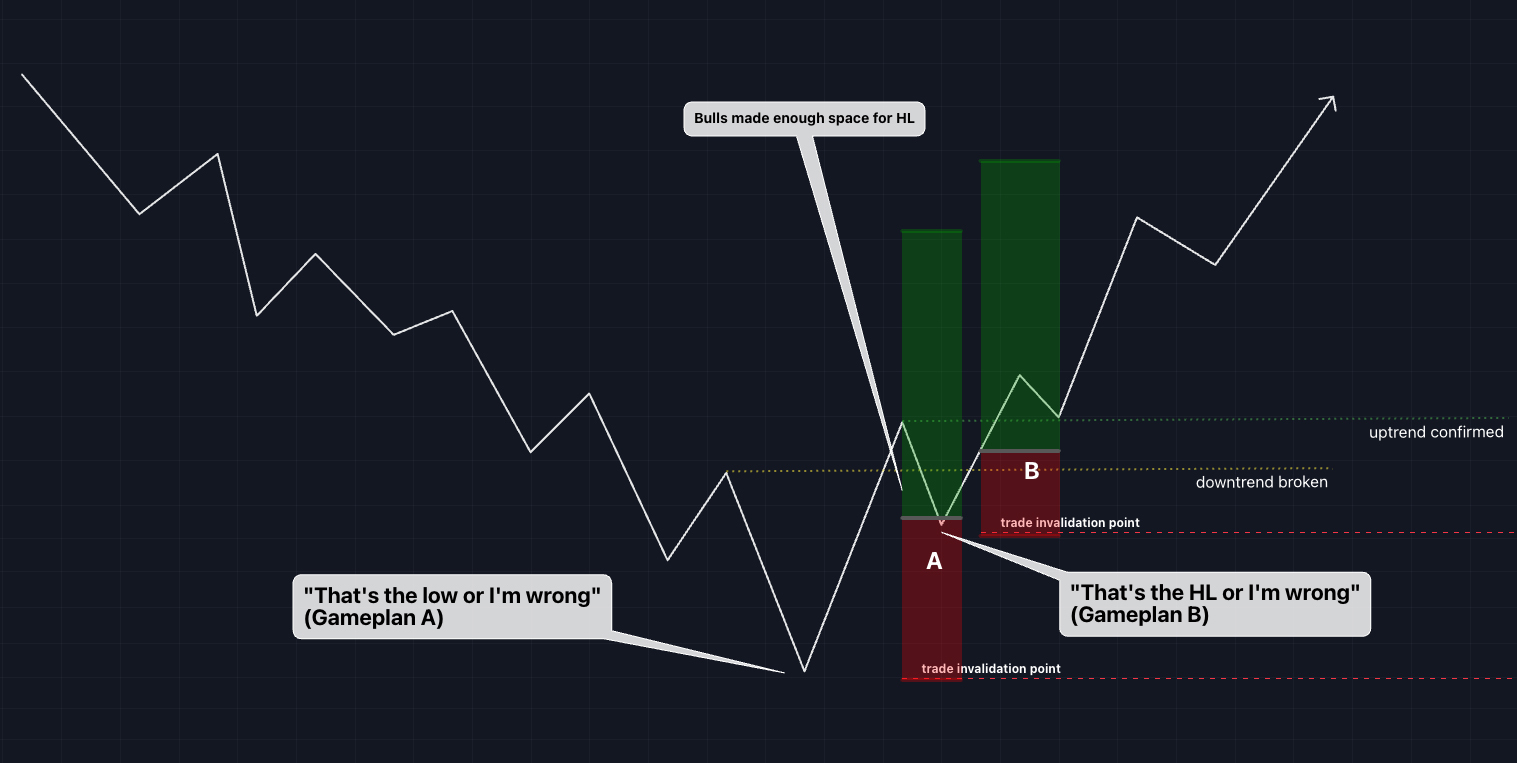
In the below hypothetical example we can see a clear downtrend into a reversal. Gameplan A is to scale in to scout the higher low, or perhaps using the nested smaller timeframe and use the bounce low as the stop loss. In gameplan B you could aggressively play off the newly forming higher low to see if it becomes a new higher low and use that as a stoploss instead. Both techniques have different risk vs confidence parameters.
Lesson 2: One Clear Statement Anchors the Trade
When Dan entered a Microsoft swing trade (which went on to be his best ever swing trade), he wasn’t just guessing off a hunch or scaling into weakness. He had a clear thesis, built around one sentence:
“This is the daily higher low or I’m wrong.”
That single line did two things:
- Defined the trade thesis, or the purpose of the entry.
- Defined the exit criteria, or the invalidation point if the thesis fails.
This concept applies across markets; crypto, stocks, bonds and commodities.
Good trades often start with one sentence you can write on a sticky note. Staying in a trade that invalidates your original thesis can also be a recipe for disaster. It's often better to exit and then re-analyze the chart.
Video: How To Use Simple Statements in Your Gameplan
