

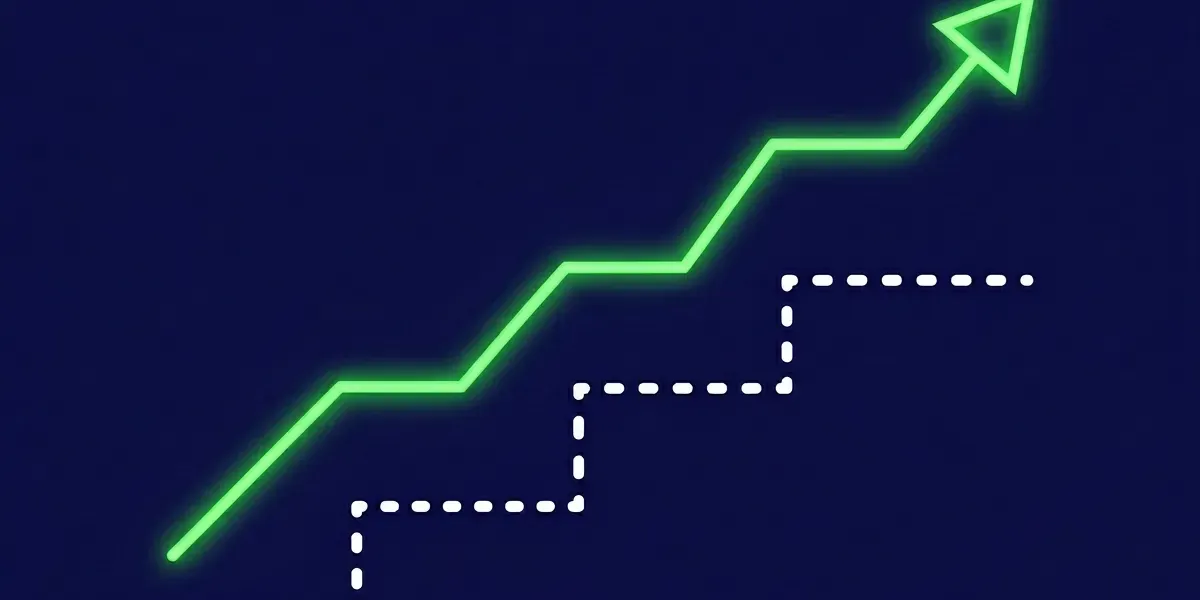

Understanding the Trailing Stop Loss


A trailing stop loss is an order type that automatically adjusts your stop level as price moves in your favor, locking in profits while still allowing your position room to continue running. Unlike a fixed stop that stays at one price regardless of how far your trade moves into profit, a trailing stop follows the market—rising with a long position as price increases, falling with a short position as price decreases—but never moving backward against you. When price eventually reverses by the trailing amount you've specified, the stop triggers and closes your position, capturing whatever gains accumulated before the reversal.
Why Protecting Profits Matters
Most trading education focuses on limiting losses through initial stop placement, but protecting profits once you have them is equally important for long-term success.
Why profit protection deserves attention:
-
Watching a winning trade turn into a losing trade damages psychology and confidence more than taking a small loss initially
-
Unrealized gains aren't yours until you close the position—protecting them converts paper profits into actual returns
-
Markets can reverse sharply without warning, erasing profits accumulated over days or weeks in a single session
-
The trailing stop loss provides a systematic approach to profit protection that doesn't rely on real-time emotional decisions
-
Knowing your profits are protected allows you to hold positions longer without anxiety about giving back gains
-
Consistent profit protection compounds over time, as protected gains fund future trading rather than evaporating
The Appeal of Letting Winners Run
The trailing stop loss addresses one of trading's most persistent challenges—balancing the desire to capture large moves against the need to protect accumulated profits.
What this article will cover:
-
How trailing stops work mechanically, including when they adjust and when they trigger
-
Different types of trailing stops from fixed distance to volatility-based approaches
-
Setting the right trailing distance to balance profit protection against premature exits
-
Market conditions when trailing stops work best and when they struggle
-
Comparing fixed stops versus trailing stops and when to use each approach
-
Common mistakes traders make when implementing trailing stops
-
How to set up trailing stops on various trading platforms
-
Trailing stop considerations across different markets including stocks, forex, futures, and crypto
-
Building trailing stop logic into a complete trading plan
How Trailing Stops Work
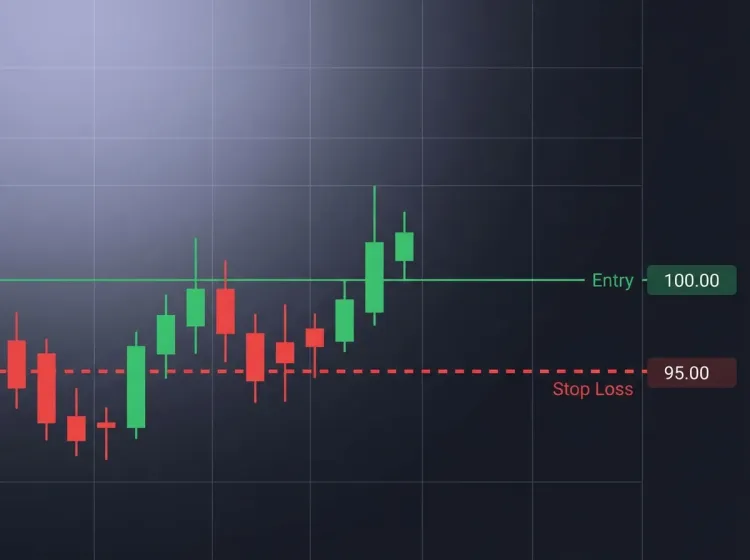
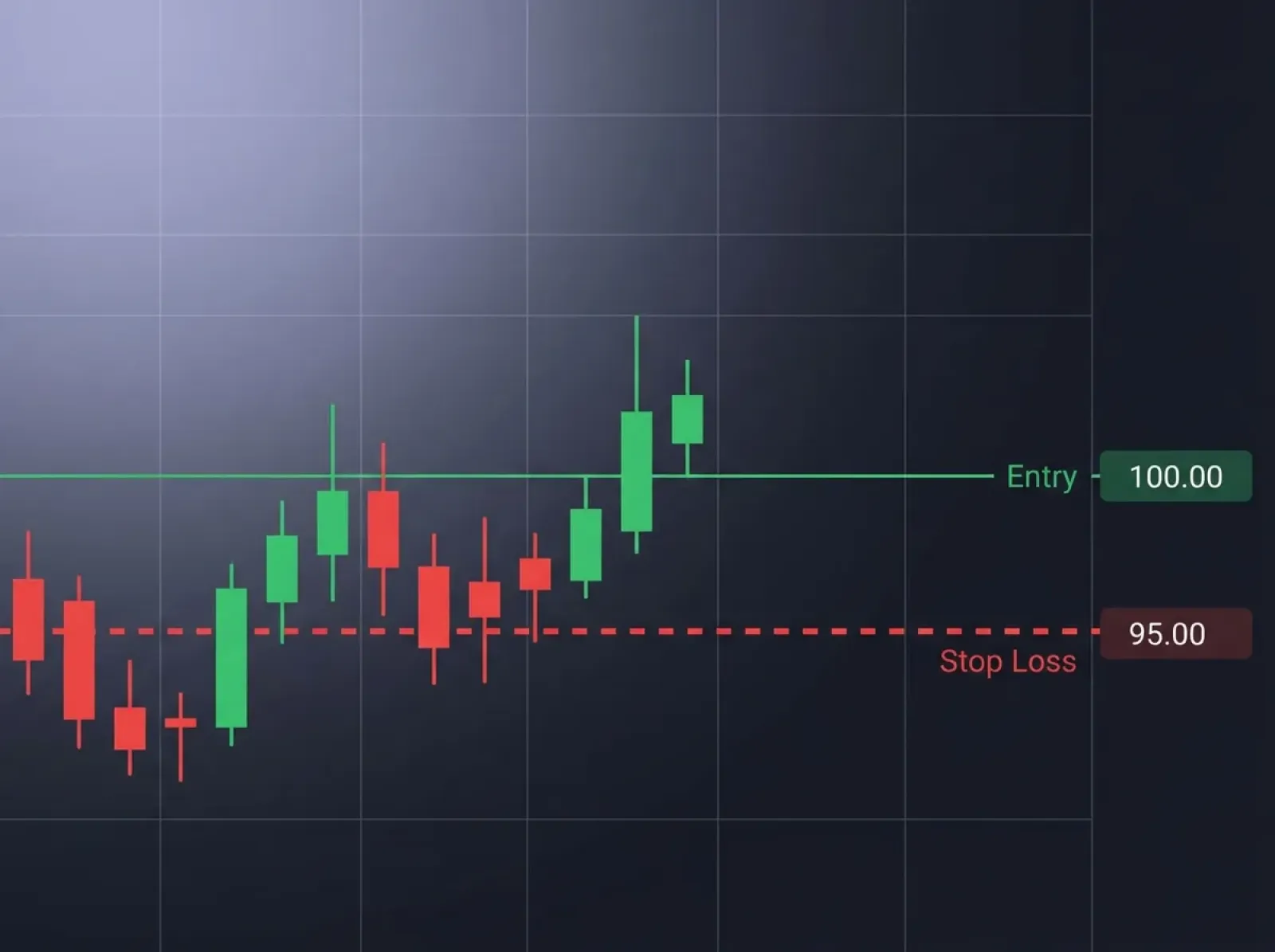
The trailing stop loss operates on a simple principle: your stop level moves with price when the position goes in your favor but stays fixed when price moves against you. This one-directional adjustment mechanism allows your protective stop to improve continuously during favorable moves while never retreating to give the market more room during pullbacks. The result is a stop that follows your winning trade like a ratchet, clicking forward with each new high (for longs) or new low (for shorts) and holding firm when retracements occur.
Basic mechanics of the trailing stop:
-
You specify a trailing distance, either as a fixed dollar amount, percentage, or number of points
-
When you enter a long position, the trailing stop begins at your entry price minus the trailing distance
-
As price rises, the stop rises by the same amount, maintaining the specified distance below the highest price reached
-
If price pulls back, the stop remains at its highest level rather than dropping with the pullback
-
When price retraces by the full trailing distance from its peak, the stop triggers and closes your position
-
For short positions, the logic reverses—the stop trails above price and moves down as price falls
How the Stop Follows Price
The trailing stop creates a floor under your profits that rises as the market moves in your favor, never allowing that floor to drop.
IF you enter a long position at $100 with a $5 trailing stop… THEN your initial stop is at $95, protecting against a $5 loss from entry.
IF price rises to $110, your stop automatically adjusts to $105… THEN you now have a $5 profit locked in regardless of what happens next.
IF price continues rising to $120, your stop adjusts to $115… THEN your locked-in profit has grown to $15, and you're still in the trade capturing the move.
IF price pulls back from $120 to $118, your stop remains at $115… THEN the stop doesn't retreat during pullbacks, holding at the highest level it reached.
IF price rallies again to $125, your stop adjusts to $120… THEN you've now locked in $20 profit and remain positioned for further gains.
IF price finally reverses and drops to $120, triggering your stop… THEN you exit with a $20 profit, having captured most of the move while being protected from the reversal.
Difference from Fixed Stops
A fixed stop loss remains at one price level regardless of how far your position moves into profit, while a trailing stop adjusts dynamically.
With a fixed stop, you set a level and it stays there. If you enter at $100 with a fixed stop at $95, that stop remains at $95 whether price goes to $105, $150, or $200. You must manually adjust the stop or use a predetermined profit target to exit winning trades. This approach provides consistency but offers no automatic profit protection—a trade that moves $50 in your favor can reverse entirely and stop you out at a loss if you don't actively manage it. The trailing stop loss eliminates this problem by automatically ratcheting your protection level higher as profits accumulate.
When the Stop Triggers
The trailing stop triggers when price reverses from its peak by the full trailing amount you specified, closing your position automatically.
The trigger point depends on the highest price reached during your trade, not your entry price. If price moved from your $100 entry to $150 before reversing, a $10 trailing stop triggers at $140—not at $90 where your initial stop was placed. This means your exit price improves throughout the trade as price moves favorably. The trigger executes as a market order when the stop price is hit, so in fast-moving or illiquid markets, your actual fill may differ from the stop level. Some platforms offer trailing stop limit orders that convert to limit orders rather than market orders when triggered, though these risk not filling if price moves through your limit.
The Bottom Line: The trailing stop loss works by maintaining a fixed distance below the highest price reached for long positions (or above the lowest price for shorts), following favorable moves automatically while never retreating during pullbacks, and triggering a position exit only when price reverses by the full trailing amount from its peak.
Types of Trailing Stops


Not all trailing stops work the same way. While the core concept remains constant—a stop that follows price and locks in profits—different methods exist for determining how far behind price the stop trails and how it adjusts. Some approaches use fixed distances that never change, while others adapt dynamically to market volatility. Some are built into broker platforms as automated order types, while others require manual adjustment or custom indicators. Understanding the various trailing stop types helps you select the approach that best matches your trading style, timeframe, and the characteristics of the securities you trade.
Types of trailing stop mechanisms:
-
Fixed distance trailing stops use a static number of points, pips, or dollars that remains constant regardless of market conditions
-
Percentage-based trailing stops trail by a fixed percentage of price, automatically scaling the dollar distance as price moves
-
ATR-based trailing stops use Average True Range to set trailing distance, adapting automatically to current volatility levels
-
Moving average trailing stops use a moving average as the stop level, exiting when price closes below (for longs) or above (for shorts) the average
-
Chandelier exits trail a multiple of ATR from the highest high of the move, combining volatility adaptation with swing-based logic
-
Parabolic SAR provides a trailing mechanism that accelerates as the trend extends, tightening the stop progressively during strong moves
-
Support and resistance trailing stops manually adjust stops to below key technical levels as price advances past them
-
Time-based trailing stops tighten the trail as holding period extends, capturing profits more aggressively in aging trades
-
Breakeven trailing stops move the stop to entry price once a specified profit threshold is reached, then trail from there
-
Manual trailing stops require you to adjust stop levels yourself based on price action, technical levels, or discretionary judgment
-
Automated trailing stops execute adjustments automatically through broker platforms or trading software without manual intervention
-
Hybrid approaches combine automated trailing with manual override capability for adapting to unusual market conditions
Choosing the Right Type
The best trailing stop loss type depends on your trading approach, the volatility of what you trade, and how much active management you want to provide.
Fixed distance trails work well when volatility is consistent and you want simplicity, but they struggle when volatility expands or contracts significantly. ATR-based and Chandelier exits adapt to changing volatility automatically, making them more robust across different market conditions but requiring indicator setup and monitoring. Moving average trails suit trend-following systems where staying above or below a moving average defines the trend you're trading. Parabolic SAR works well for capturing extended trends but can tighten too aggressively during consolidations. Manual trailing offers maximum flexibility but requires constant attention and invites emotional decision-making. Automated trailing removes emotion but may not adapt to context the way discretionary adjustment can.
Keep In Mind: Different trailing stop loss types suit different trading styles and market conditions—fixed distance trails offer simplicity, ATR-based methods adapt to volatility, moving average trails align with trend-following logic, and manual approaches provide flexibility at the cost of requiring active management and emotional discipline.
Setting the Right Trailing Distance


The trailing distance you choose determines everything about how your trailing stop performs. Set it too tight and normal market noise will stop you out repeatedly, capturing only small portions of moves that could have been much larger. Set it too loose and you'll give back excessive profits before the stop triggers, exiting after significant reversals have already eroded your gains. Finding the right balance requires understanding the typical volatility of what you trade, matching your trailing distance to your timeframe, and testing different approaches to see what actually works rather than guessing.
Too Tight vs. Too Loose
The tension between capturing maximum profit and avoiding premature exits defines the trailing stop calibration challenge.
DO analyze the typical pullback depth within trends for the securities you trade before selecting a trailing distance.
DO consider your timeframe—shorter timeframes generally require tighter trails while longer timeframes need wider trails.
DO accept that no trailing distance is perfect—you're choosing a tradeoff between profit protection and position retention.
DO start wider than you think necessary and tighten based on testing rather than starting too tight and getting stopped repeatedly.
DO adjust trailing distance based on the specific security's volatility rather than using one size for everything.
DON'T set trailing stops so tight that ordinary intraday or intrabar fluctuations trigger exits constantly.
DON'T set trailing stops based on what you hope to keep rather than what the market's actual movement patterns suggest.
DON'T use the same trailing distance for a low-volatility utility stock and a high-volatility growth stock.
DON'T ignore the evidence if your trailing stops consistently exit positions right before continuation moves.
DON'T refuse to widen your trail when data shows you're getting stopped out prematurely on most trades.
Using ATR to Calibrate Trailing Distance
Average True Range provides an objective measure of recent volatility that automatically scales your trailing distance to current market conditions.
ATR calculates the average range of price movement over a specified period, typically 14 bars, giving you a number that represents how much the security typically moves. Using a multiple of ATR as your trailing distance—such as 2x ATR or 3x ATR—creates a trail that adapts automatically as volatility expands or contracts. During calm markets, ATR shrinks and your trail tightens, protecting profits more aggressively. During volatile periods, ATR expands and your trail widens, giving positions room to breathe without getting stopped by normal fluctuations. A trailing stop loss set at 2x ATR means price must reverse by twice the average recent range before triggering your exit, which typically allows normal pullbacks while catching genuine reversals.
Testing Different Distances
The only way to know what trailing distance works for your strategy is testing various approaches against historical data and live results.
How to test trailing stop distances:
-
Backtest your strategy with multiple trailing distances to compare average profit per trade, win rate, and maximum adverse excursion
-
Track how often each distance stops you out before significant continuation moves versus catching genuine reversals
-
Record the profit captured as a percentage of maximum favorable excursion—how much of each move did you actually keep
-
Compare results across different market conditions including trending periods, ranging periods, and high-volatility events
-
Test both fixed distances and volatility-adjusted approaches like ATR multiples to see which performs better for your style
-
Forward test your chosen distance on live trades with small size before committing to it fully
-
Review stopped-out trades to assess whether exits were appropriate or premature based on subsequent price action
-
Remain willing to adjust your trailing distance as you gather more data rather than treating your initial choice as permanent
The right trailing stop loss distance is the one that captures a meaningful portion of favorable moves while surviving normal pullbacks—and finding it requires testing against actual data rather than guessing based on intuition or arbitrary round numbers.
When Trailing Stops Work Best


Trailing stops aren't universally superior to fixed stops or profit targets—they excel in specific market conditions and struggle in others. Understanding when trailing stops have an edge helps you deploy them strategically rather than applying them blindly to every trade. The trailing stop loss shines when markets trend, when moves can extend beyond initial expectations, and when capturing the bulk of a move matters more than exiting at a precise level.
Trending Markets with Sustained Moves
Trailing stops perform best when price makes directional moves that persist long enough for the trail to ratchet up significantly.
Conditions that favor trailing stops:
-
Strong trends where price makes higher highs and higher lows (for longs) with pullbacks that don't exceed your trailing distance
-
Momentum breakouts that extend beyond initial measured move targets
-
Sector or market-wide moves where multiple securities trend together, increasing the probability of continuation
-
Low-volatility trends where pullbacks are shallow relative to the overall move
-
News-driven moves that establish new trading ranges with sustained follow-through
-
Earnings reactions that gap and continue rather than filling the gap immediately
-
Multi-day or multi-week swings where price travels significantly from entry before reversing
Momentum Strategies and Swing Trading
Trading approaches designed to capture extended moves benefit most from trailing stop logic.
Momentum strategies specifically seek securities making significant directional moves, and the trailing stop aligns perfectly with this goal. When you're trying to ride a runner—a stock that keeps going far beyond typical expectations—a fixed profit target exits you too early while a trailing stop keeps you in as long as the move continues. Swing traders holding positions for multiple days face the challenge of overnight gaps and extended moves that exceed initial targets. The trailing stop loss allows swing traders to capture these extensions without requiring them to predict exactly where the move will end. The trail handles the exit timing automatically, staying in during continuation and exiting when the move finally exhausts.
Volatile Securities with Large Potential
Securities capable of making substantial moves justify the trailing approach because the potential extension exceeds what fixed targets typically capture.
Did You Know? Studies of momentum stocks show that the biggest winners often move 50-100% or more beyond initial breakout levels, and fixed profit targets consistently leave significant money on the table by exiting these trades too early.
Did You Know? Trailing stops historically capture 60-80% of trending moves on average, compared to fixed targets that often capture only 30-50% of the eventual move when set at typical measured move distances.
Quick Tip: Apply trailing stops to your highest-conviction momentum trades where extension potential is greatest, while using fixed targets for lower-conviction setups where capturing a defined move matters more than maximizing potential.
Position Trades Capturing Larger Moves
Longer-term position trades lasting weeks or months represent ideal trailing stop territory where moves can extend dramatically.
Position traders seeking to capture major trend moves—the kind that can double or triple an account's returns on a single trade—need exit mechanisms that don't arbitrarily cap upside. Fixed targets based on initial analysis almost always underestimate how far strong trends can travel. A trailing stop loss allows position traders to stay with trends as long as they persist, riding multi-month moves without needing to predict the exact top or bottom. The trail provides ongoing profit protection while remaining positioned for continuation, exiting only when the trend definitively reverses by the trailing distance.
Remember: Trailing stops work best in trending markets with sustained directional moves, momentum strategies seeking extended runners, swing trades with multi-day holding periods, and position trades capturing larger moves—essentially whenever price can travel significantly in your favor before reversing, justifying the trailing approach over fixed exits.
When Trailing Stops Struggle


Trailing stops aren't the right tool for every situation, and forcing them into conditions where they don't fit produces frustrating results. The very mechanism that makes trailing stops powerful in trends—following price and locking in gains—becomes a liability when markets chop sideways, when volatility creates constant whipsaws, or when your strategy depends on capturing quick moves to defined targets. Recognizing when trailing stops struggle saves you from applying them inappropriately and blaming the tool for underperformance that's actually a mismatch between method and market conditions.
Conditions where trailing stops underperform:
-
Choppy, ranging markets where price oscillates without sustained directional movement, triggering trails repeatedly during normal fluctuations
-
Consolidation periods where price moves up, triggers enthusiasm, then reverses back through trailing levels before continuing
-
High-volatility securities with frequent whipsaws that exceed typical trailing distances even within ongoing trends
-
Securities prone to sharp shakeouts designed to trigger stops before resuming the original direction
-
Mean-reversion strategies where you're trading against the prevailing move and expecting price to snap back to a level rather than continue
-
Fade trades where the entire profit potential is defined by the distance to a reversion target, not by trend continuation
-
Short-term scalping where moves are too small and quick for trailing stops to add value before reaching defined targets
-
Intraday trades in choppy conditions where noise exceeds signal and trails trigger constantly
-
News-driven spikes that create immediate reversals rather than sustained moves, with price reversing before trails can ratchet meaningfully
-
Earnings gaps that fill quickly rather than extending, triggering trails during the gap fill despite the trade being fundamentally correct
-
Low-liquidity securities where gaps through your trailing stop level create fills far worse than expected
-
Options positions where time decay and volatility changes complicate the relationship between underlying price movement and position value
Matching Tools to Conditions
The trailing stop loss works best when moves can extend beyond initial expectations, and it struggles when moves are capped, choppy, or prone to immediate reversal.
When you're trading a strategy that expects price to reach a specific level and then reverse or stall—mean reversion, support/resistance bounces, gap fills—a fixed profit target makes more sense than a trail that waits for reversal. When you're scalping for quick profits measured in cents rather than dollars, the trailing mechanism adds complexity without benefit since you'll exit at your target long before a trail would provide value. When markets are ranging and directionless, trailing stops get triggered during normal oscillations, producing a series of small profits or breakeven exits that would have been winners with fixed targets. The key is matching your exit mechanism to what you actually expect price to do. Use trailing stops when you expect extension. Use fixed targets when you expect defined moves to specific levels
Fixed Stops vs. Trailing Stops


The choice between fixed profit targets and trailing stops isn't about which approach is objectively better—it's about which approach matches your strategy, the market conditions, and the behavior of what you're trading. Each method has genuine advantages that make it superior in certain contexts and inferior in others. Understanding these tradeoffs allows you to deploy the right tool for each situation rather than religiously committing to one approach regardless of circumstances.
Advantages of fixed profit targets:
-
Certainty about exit price assuming no gaps, allowing precise risk-reward calculation before entry
-
Higher win rate since you exit as soon as target is reached rather than waiting for reversals
-
Works well in ranging markets where price oscillates between defined levels
-
Simpler execution with no need to monitor and adjust stop levels
-
Captures full defined move without giving back any portion to trailing mechanism
-
Better for mean-reversion strategies where you expect price to reach a specific level and stall
-
Reduces decision fatigue by eliminating judgment calls about trailing distance or timing
-
Prevents watching winners turn into smaller winners or breakeven trades
Advantages of Trailing Stops
Trailing stops offer different benefits that make them superior when moves can extend significantly beyond initial expectations.
Advantages of trailing stop exits:
-
Captures extended moves that exceed initial measured move targets
-
Doesn't require predicting exactly where the move will end
-
Automatically adapts to moves of varying sizes rather than cutting all winners at the same distance
-
Stays with runners while protecting accumulated profits along the way
-
Works better in trending markets where continuation probability is high
-
Removes the regret of watching positions continue significantly after fixed target exits
-
The trailing stop loss allows participation in outlier moves that can dramatically impact overall returns
-
Provides ongoing profit protection without requiring constant monitoring and manual adjustment
Combining Both Approaches
Many successful traders use hybrid approaches that capture the benefits of both fixed targets and trailing stops.
A common hybrid strategy involves taking partial profits at a fixed target while trailing the remainder. You might exit half your position when price reaches a 2:1 reward-to-risk target, locking in a guaranteed winner, then trail the remaining half to capture any extension. This approach provides the psychological benefit of realizing profits at a defined level while maintaining exposure to larger moves. Another hybrid involves using fixed targets in ranging conditions and switching to trailing stops when trends develop. The key is recognizing that these tools serve different purposes and combining them thoughtfully rather than treating the choice as binary.
When to Use Each Method
Matching your exit approach to market conditions and strategy type produces better results than applying one method universally.
IF you're trading a mean-reversion setup where you expect price to reach a specific support or resistance level… THEN use a fixed profit target at that level since you don't expect price to extend beyond it.
IF you're trading a momentum breakout where strong stocks can run significantly beyond initial targets… THEN use a trailing stop to stay with the move and capture whatever extension develops.
IF you're scalping for quick profits in and out within minutes… THEN use fixed targets since the moves are too short for trailing stops to provide value.
IF you're swing trading with multi-day holding periods in a trending market… THEN use trailing stops or hybrid approaches to capture moves that can extend well beyond initial analysis.
IF market conditions are choppy and directionless… THEN use fixed targets to exit before reversals trigger, rather than trails that will stop you out during normal oscillations.
IF a clear trend is established and you have a high-conviction position… THEN use a trailing stop loss to ride the trend as long as it persists without artificial caps on upside.
Hybrid Strategies for Different Conditions
Building flexibility into your trading plan allows you to adapt exit approaches based on what the market is actually doing.
Hybrid approaches that adapt to conditions:
-
Use fixed targets as the default in choppy markets and switch to trailing stops when clear trends emerge
-
Take partial profits at fixed targets and trail the remainder, adjusting the ratio based on trend strength
-
Start with a fixed initial target, then switch to a trailing stop if price reaches that level and shows continuation momentum
-
Use tighter trails in volatile conditions and wider trails or fixed targets in calm conditions
-
Apply trailing stops to momentum strategies and fixed targets to mean-reversion strategies within the same portfolio
-
Set a fixed ultimate target for the full position but trail a portion in case price reaches target earlier than expected
-
Review recent performance to determine whether fixed or trailing approaches have worked better and adjust accordingly
Keep In Mind: The choice between fixed profit targets and trailing stops isn't permanent or universal—the trailing stop loss excels when moves can extend beyond initial expectations, fixed targets excel when moves are capped or choppy, and hybrid approaches that combine both methods often capture the benefits of each while minimizing their weaknesses.
Common Trailing Stop Mistakes


The trailing stop is a powerful tool, but like any tool, it can be misused in ways that undermine its effectiveness. Many traders implement trailing stops poorly and then conclude the approach doesn't work, when the problem was execution rather than concept. Understanding the most common mistakes helps you avoid them and implement trailing stops in ways that actually capture the benefits they're designed to provide.
Common trailing stop mistakes:
-
Setting trails too tight for the security's volatility, getting stopped out by normal fluctuations that don't represent genuine reversals
-
Using the same trailing distance for all securities regardless of their individual volatility characteristics
-
Trailing too early before the move develops, starting the trail immediately at entry rather than allowing the position to move into profit first
-
Activating trails before price has moved enough to make trailing meaningful, resulting in breakeven or tiny-profit exits on trades that needed more room
-
Not adjusting for changing volatility, using fixed distances that become too tight when volatility expands or too loose when it contracts
-
Ignoring ATR or other volatility measures that would inform appropriate trailing distance adjustments
-
Manual trailing driven by emotion rather than rules, tightening trails out of fear during pullbacks or widening them out of greed during advances
-
Moving trails based on hope, anxiety, or real-time emotional reactions rather than predetermined criteria
-
Abandoning the trailing stop system when it triggers at inopportune times, concluding the approach is broken after a few frustrating exits
-
Overriding trailing stops to let trades run further, then watching profits evaporate when the reversal continues
-
Removing trailing stops entirely during winning trades, believing this particular move is different and doesn't need protection
-
Setting trails based on arbitrary round numbers rather than levels informed by actual price behavior and volatility
-
Failing to account for gaps that can trigger stops far beyond the trailing level, especially in securities prone to overnight moves
-
Using broker-provided trailing stop orders without understanding their limitations, such as only trailing during market hours
-
Trailing too aggressively in late stages of moves, tightening stops just as volatility typically increases near trend exhaustion
Avoiding These Pitfalls
Most trailing stop loss mistakes stem from either poor calibration to the security's actual behavior or emotional interference that overrides systematic rules.
The calibration mistakes—setting trails too tight, not adjusting for volatility, trailing too early—can be fixed through testing and data analysis. Study how the securities you trade actually move, measure typical pullback depths within trends, and set trails that survive normal fluctuations while catching genuine reversals. The emotional mistakes—manual trailing driven by fear or greed, abandoning the system after frustrating exits, overriding trails because this time feels different—require discipline and commitment to rules. Write down your trailing stop rules before entering trades. Follow them regardless of how you feel in the moment.
Review results over many trades rather than judging the approach based on individual outcomes. A trailing stop loss that triggers before a big move or slightly after the ideal exit point isn't a system failure—it's the normal operation of a mechanism that cannot predict the future and shouldn't be abandoned because it can't achieve perfection.
Implementing Trailing Stops on Your Platform
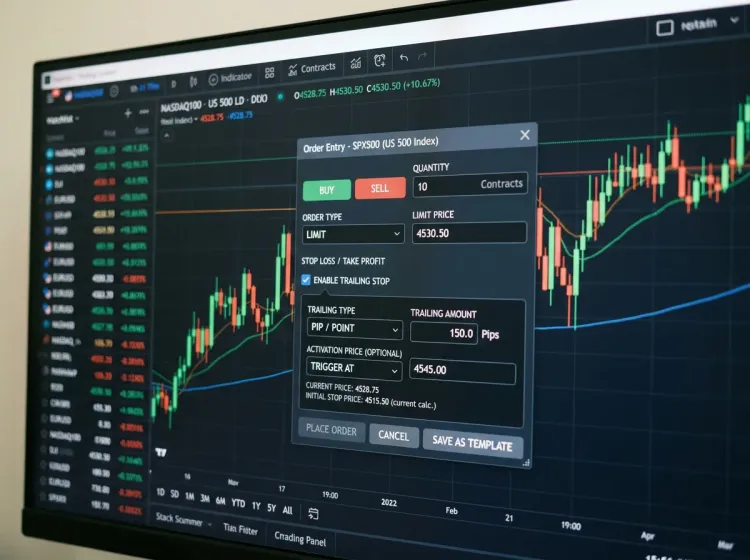
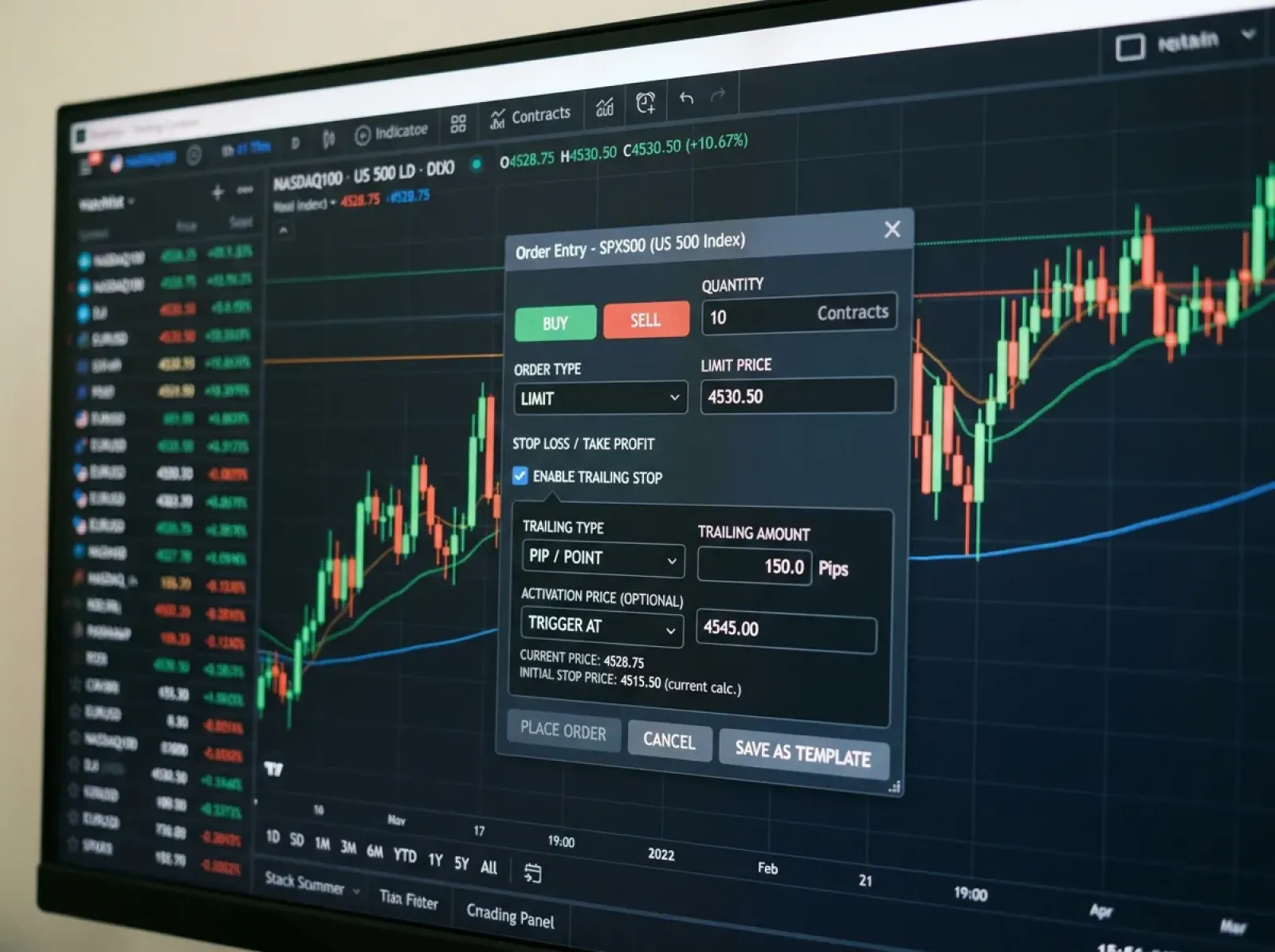
Understanding trailing stop concepts means little if you can't actually implement them in your trading. Different platforms offer varying levels of trailing stop functionality, from basic fixed-distance trails built into the order system to sophisticated volatility-adjusted mechanisms requiring custom setup. Knowing what your platform offers—and its limitations—helps you implement trailing stops effectively or find workarounds when native functionality falls short.
Broker Platform Trailing Stop Features
Most major brokers offer some form of trailing stop order, though capabilities vary significantly between platforms.
What broker platforms typically offer:
-
Fixed distance trailing stops specified in points, dollars, or percentage that adjust automatically as price moves favorably
-
Activation thresholds that begin trailing only after price reaches a specified profit level
-
Order duration settings determining whether trails remain active until canceled, for the day only, or through extended hours
-
Real-time adjustment displays showing current trailing stop level relative to market price
-
Modification capabilities allowing you to change trailing distance or cancel the order while the position is open
-
Mobile app access for monitoring and adjusting trailing stops away from your primary trading station
-
Order confirmation screens showing trail parameters before submission
-
Position-linked stops that automatically cancel if the underlying position is closed through other means
Manual Trailing Stop Management
When broker tools don't offer the sophistication you need, manual management provides flexibility at the cost of requiring active attention.
Implementing manual trailing stops:
-
Set price alerts at levels where you would adjust your stop, triggering notifications rather than automatic order changes
-
Use charting software to display ATR or other indicators that inform trailing adjustments
-
Create a spreadsheet or trading journal tracking your positions and current trailing stop levels based on your rules
-
Schedule specific times to review positions and adjust stops rather than watching continuously
-
Define rules in advance specifying exactly when and how you'll adjust stops, reducing real-time decision-making
-
Consider third-party trading tools that offer more sophisticated trailing mechanisms than native broker functionality
-
Use conditional order features if your broker offers them to create more complex trailing logic
-
Accept that manual management introduces human error and emotional interference risks that automated systems avoid
-
Document your manual trailing rules clearly enough that you could follow them mechanically without judgment calls
The Bottom Line: Implementing a trailing stop loss effectively requires understanding your broker's capabilities and limitations, choosing between automated convenience and manual flexibility, setting up alerts and notifications that keep you informed without requiring constant monitoring, and recognizing that sophisticated trailing approaches like ATR-based or indicator-based trails may require workarounds when native platform functionality only supports basic fixed-distance trailing.
Trailing Stops in Different Markets


Trailing stops work across all tradeable markets, but each market has characteristics that affect how you should implement them. Volatility patterns, trading hours, liquidity profiles, and gap behavior all differ between equities, forex, futures, crypto, and options. A trailing distance that works perfectly for a large-cap stock may be entirely inappropriate for a cryptocurrency or a thinly traded futures contract. Understanding these market-specific considerations helps you calibrate trailing stops appropriately rather than applying one approach universally.
Market-specific trailing stop considerations:
-
Equities trade during defined market hours with overnight gaps that can trigger stops far beyond intended levels
-
Large-cap stocks typically have tighter effective trailing distances due to lower volatility and deeper liquidity
-
Small-cap and penny stocks require wider trails due to higher volatility and potential for significant percentage swings
-
ETFs generally behave like the underlying basket, with index ETFs being less volatile than sector or leveraged ETFs
-
Forex pairs trade 24 hours on weekdays, reducing gap risk but requiring attention to session volatility differences
-
Major forex pairs offer deep liquidity and tight execution, while exotic pairs can have wider spreads and slippage
-
Forex volatility varies by session, with overlapping London-New York hours typically showing the most movement
-
Futures contracts have specific trading hours depending on the product, with potential for limit moves and gaps
-
Futures volatility varies dramatically between products—treasury futures behave nothing like crude oil or natural gas
-
Cryptocurrency markets trade 24/7 including weekends, eliminating gap risk but requiring continuous monitoring or automated systems
-
Crypto volatility often exceeds traditional markets significantly, requiring wider trailing distances to avoid constant triggering
-
Crypto liquidity varies enormously between major coins and altcoins, affecting execution quality when trails trigger
-
Options present unique challenges since the underlying price movement doesn't directly translate to option price movement
-
Options decay over time, meaning a trailing stop based on option price may trigger due to theta decay rather than directional reversal
-
Options spreads and multi-leg positions complicate trailing stop implementation, often requiring management of the underlying rather than the option itself
Adapting Your Approach
The trailing stop loss requires calibration to each market's specific characteristics rather than a one-size-fits-all implementation.
Equities and ETFs offer the most straightforward trailing stop application, with the primary consideration being overnight gap risk and volatility differences between large-caps, small-caps, and leveraged products. Use ATR-based trails that automatically adjust to each security's volatility, and be aware that stops set during market hours won't protect you from adverse overnight gaps. Forex allows 24-hour trailing during weekdays, reducing gap risk significantly, but you must account for volatility differences across trading sessions and adjust trailing distances for the specific pair's typical movement.
Futures require product-specific calibration since volatility profiles vary enormously—trail treasury futures very differently than you would natural gas or agricultural commodities. Cryptocurrency demands the widest relative trails due to extreme volatility, and the 24/7 market requires either automated systems or acceptance that you can't monitor positions constantly. Options generally shouldn't use trailing stops on the option position itself due to the complexity of how option prices move; instead, consider trailing stops on the underlying or managing option exits based on delta, time, or the underlying's technical levels rather than the option's price directly.
Making the Trailing Stop Loss Work for You


The trailing stop loss solves a genuine problem that every trader faces: how to protect profits without arbitrarily capping upside. Fixed profit targets exit you at predetermined levels regardless of whether the move has more to give, while no exit strategy at all allows winners to become losers when reversals arrive. The trailing stop provides a middle path—staying with moves as long as they continue while automatically ratcheting your protection level higher as profits accumulate. It's not a perfect tool, and it won't maximize every trade, but it provides systematic profit protection that removes the emotional guesswork from deciding when enough is enough.
Building Trailing Logic into Your Trading Plan
The trailing stop loss becomes most powerful when integrated thoughtfully into a complete trading plan rather than applied as an afterthought.
Define in advance which setups warrant trailing stops versus fixed targets based on the market conditions and strategy type. Specify your trailing method—fixed distance, ATR-based, moving average, or manual—and the exact parameters you'll use for different securities or volatility environments. Document when you'll activate the trail, whether immediately at entry or after price reaches a profit threshold. Write down your rules clearly enough that you could follow them mechanically without real-time judgment calls that invite emotional interference. Then commit to following those rules across enough trades to evaluate whether the approach works, resisting the temptation to abandon or override the system based on individual outcomes that feel frustrating.
Balance automation with appropriate discretion by using automated trails for execution while maintaining awareness of context that might warrant adjustment—but err toward following your rules rather than overriding them based on feelings. Maintain realistic expectations that trailing stops will sometimes exit before big moves and sometimes exit after significant retracements. Neither outcome represents system failure. The trailing stop loss captures a portion of favorable moves while protecting against complete reversal, and evaluating its performance requires looking at results across many trades rather than judging based on individual exits that inevitably seem poorly timed in hindsight.
