



The Hidden Influence of Anchoring Bias


Anchoring bias is the tendency to rely too heavily on the first piece of information encountered when making decisions, allowing that initial reference point to disproportionately influence subsequent judgments. In trading, this manifests as fixating on prices that feel significant—your entry price, a stock's 52-week high, an analyst's target, or a round number like $100—and letting those anchors distort your assessment of what a position is actually worth right now. The bias operates largely below conscious awareness, shaping your decisions even when the anchor is completely irrelevant to the current situation. A stock doesn't care what you paid for it, yet your brain treats that entry price as meaningful information when deciding whether to hold or sell.
Why Traders Are Particularly Susceptible
Trading involves constant exposure to numbers, prices, and reference points that create anchoring opportunities at every turn.
Why anchoring affects traders so strongly:
-
Every trade creates an immediate anchor in the form of your entry price
-
Price charts display historical levels that feel significant even when market conditions have changed
-
Analysts, media, and other traders constantly supply external anchors through price targets and predictions
-
Round numbers like $50, $100, or $1,000 create natural psychological anchors that affect both individual and collective behavior
-
The emotional intensity of trading strengthens memory formation around price points, making anchors stickier
-
Uncertainty about fair value makes traders more likely to grab onto any available reference point
-
The speed of trading decisions doesn't allow time for the deliberate thinking that might override anchoring
The Invisible Influence
Anchoring bias operates without your permission and often without your awareness, making it one of the most insidious cognitive traps in trading.
What makes anchoring bias particularly dangerous is that it doesn't feel like a bias—it feels like rational analysis. When you think "this stock is cheap because it used to trade at $150," you're not consciously recognizing that you've anchored to an arbitrary historical price. When you hold a losing position waiting to get back to even, you don't experience this as irrational anchoring to your entry price—it feels like prudent patience. The bias hides in plain sight, disguised as reasonable thinking, while quietly distorting your decisions and damaging your results.
What This Article Covers
This article explains how anchoring bias affects trading decisions and provides practical strategies for reducing its impact.
Topics this article will explain:
-
The psychological origins of anchoring bias and why it persists even when we're aware of it
-
Specific ways anchoring appears in trading, from entry price fixation to round number effects
-
The real-world cost of anchoring in terms of held losers, cut winners, and missed opportunities
-
How to recognize anchoring in your own decision-making process
-
Practical strategies for overcoming anchoring bias through systematic rules and awareness
-
When anchoring effects can actually be useful and how to distinguish legitimate reference points from arbitrary anchors
What Is Anchoring Bias?


Anchoring bias is a cognitive shortcut where the brain latches onto an initial piece of information—the anchor—and uses it as a reference point for all subsequent judgments, even when that information is irrelevant or arbitrary. The bias was identified by psychologists Daniel Kahneman and Amos Tversky in the 1970s as part of their groundbreaking research on how humans actually make decisions versus how we assume we make them. Their work revealed that we don't evaluate options in isolation based purely on their merits. Instead, we unconsciously compare everything to whatever reference point happens to be available, and that reference point pulls our estimates and decisions toward itself like gravity.
How the Brain Uses Reference Points
The brain relies on anchoring because evaluating things in absolute terms is cognitively expensive, while relative comparisons are fast and easy.
How reference points shape judgment:
-
When estimating unknown quantities, the brain starts from available information and adjusts—but typically adjusts insufficiently
-
The anchor serves as a starting point that biases the final estimate in its direction
-
This happens automatically, without conscious awareness or deliberate choice
-
Even random or obviously irrelevant anchors affect judgments when tested experimentally
-
The brain treats any available number as potentially informative, even when it clearly isn't
-
Anchoring operates through both conscious comparison processes and unconscious priming effects
-
The less certainty you have about the correct answer, the more heavily anchors influence your judgment
The Original Kahneman and Tversky Research
The classic anchoring experiments demonstrated just how easily arbitrary numbers influence supposedly rational estimates.
In one famous study, participants spun a wheel that landed on either 10 or 65, then estimated the percentage of African countries in the United Nations. Those who saw 65 on the wheel estimated significantly higher percentages than those who saw 10—despite the wheel number being obviously random and irrelevant to the question. Other experiments showed that anchoring persists even when participants are warned about it, offered incentives for accuracy, or explicitly told the anchor is meaningless. The effect appears across experts and novices, across different domains, and across cultures. Anchoring bias isn't a failure of intelligence or effort—it's a built-in feature of how human cognition operates.
Why Anchoring Persists
Knowing about anchoring bias doesn't make you immune to it, which is part of what makes it so dangerous for traders.
The persistence of anchoring despite awareness stems from how deeply automatic the process is. Anchoring doesn't happen in the conscious, deliberate part of your mind that learns about biases and tries to correct for them. It happens in the fast, intuitive system that generates judgments before your conscious mind even engages. By the time you're thinking about whether you're anchored, the anchor has already influenced your perception. You can try to adjust away from the anchor, but research shows people consistently under-adjust, leaving residual bias even when actively trying to correct for it.
The Bottom Line: Anchoring bias is a fundamental cognitive shortcut where initial reference points disproportionately influence subsequent judgments, operating automatically below conscious awareness and persisting even when we know about it—making it a particularly dangerous bias for traders who face constant exposure to prices, targets, and levels that can anchor their thinking without their knowledge or consent.
How Anchoring Bias Appears in Trading
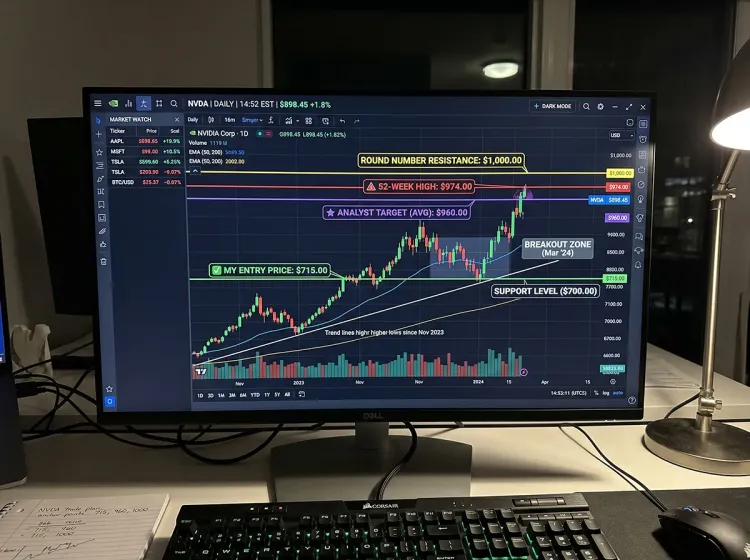
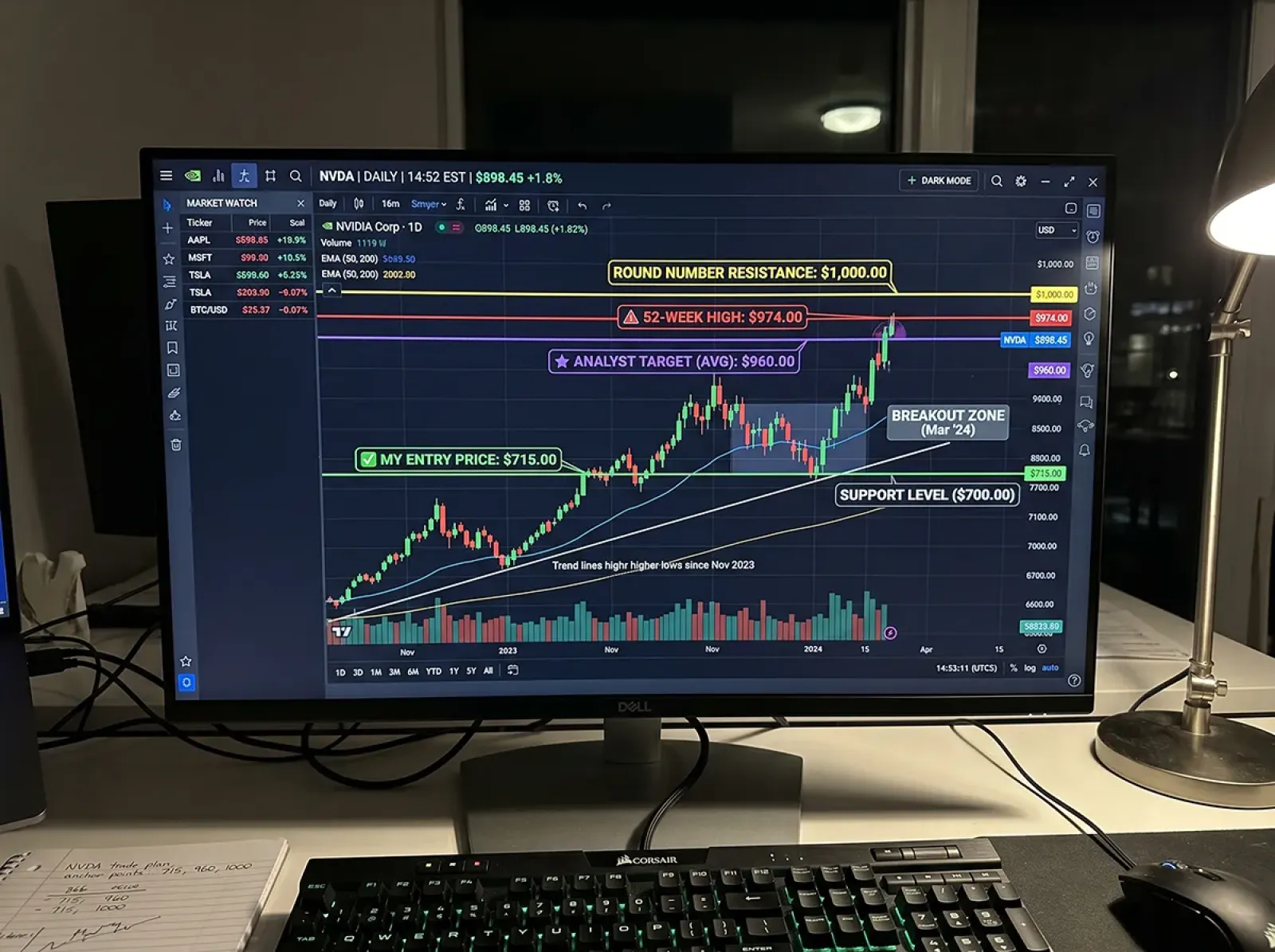
Anchoring bias infiltrates trading decisions through multiple channels, creating reference points that feel meaningful but often distort rational analysis. Some anchors are personal—like your entry price or a past trade that worked well. Others are external—analyst targets, media coverage, or prices that other traders seem to focus on. And some are structural—round numbers or historical levels that attract collective attention. Recognizing these different anchor types helps you identify when irrelevant reference points might be influencing your decisions.
Common ways anchoring bias appears in trading:
-
Entry price anchoring: Treating your buy price as meaningful information about when to sell, holding losers waiting to get back to even, or selling winners simply because they've risen enough above entry to feel like a win
-
Recent high anchoring: Believing a stock that fell from $150 to $80 is cheap because it used to trade higher, without evaluating whether current fundamentals justify the previous price
-
Recent low anchoring: Thinking a stock at $50 is expensive because it recently traded at $30, even if the move higher reflects legitimate improvement
-
52-week high and low anchoring: Using arbitrary calendar-based reference points to judge whether current prices represent value or danger
-
Analyst price target anchoring: Letting external targets shape your expectations even when you haven't independently verified the analysis behind them
-
Consensus estimate anchoring: Allowing Wall Street expectations to frame your thinking about what constitutes a good or bad earnings report
-
Round number anchoring: Placing undue significance on $100, $50, $10, or other psychologically appealing price levels
-
Previous support and resistance anchoring: Assuming old levels remain relevant despite changed circumstances
-
Past performance anchoring: Expecting a stock that returned 40% last year to produce similar returns, or avoiding a strong performer because it "already made its move"
-
Position size anchoring: Using your previous position size as a reference for current sizing rather than evaluating fresh based on current conditions
-
Stop loss anchoring: Setting stops based on your pain threshold or entry price rather than where the trade is actually invalidated
-
Profit target anchoring: Choosing exit points based on desired returns or round numbers rather than where price action suggests taking profits
Keep In Mind: Anchoring bias in trading operates through both personal reference points like your entry price and external reference points like analyst targets or historical highs—and in both cases, the anchor feels like relevant information even when it's actually irrelevant to the current decision, which is precisely why the bias is so difficult to overcome.
Entry Price Anchoring: The Most Common Trap


Of all the ways anchoring bias manifests in trading, entry price fixation is the most universal and most damaging. The moment you buy a stock, that purchase price becomes psychologically significant in a way that has nothing to do with market reality. You start measuring everything relative to that number—whether you're up or down, whether the trade is working or failing, whether to hold or sell. But the market doesn't know or care what you paid. Your entry price is meaningful only to your P&L and your ego, not to the future direction of the stock. Letting that number influence your decisions means making choices based on personal accounting rather than market reality.
Why Your Buy Price Shouldn't Affect Sell Decisions
The decision to sell should be based on current conditions and forward-looking analysis, not on where you happened to enter.
DO ask whether you would buy the stock at current prices if you didn't already own it—if no, that's information about whether to hold.
DO evaluate the current setup, trend, and risk-reward on its own merits without reference to your entry.
DO recognize that the market is offering you today's price, and that price reflects current conditions regardless of your history with the position.
DO treat every day as a new decision about whether this position deserves capital allocation.
DO accept that getting back to even is not a legitimate trading goal—it's an emotional milestone with no market relevance.
DON'T wait to sell a position until it returns to your entry price when the reason for holding has disappeared.
DON'T measure trade success purely by distance from entry rather than by quality of execution and decision-making.
DON'T hold a losing position solely because selling would crystallize a loss that currently exists only on paper.
DON'T let being underwater prevent you from cutting a position that you would never enter at current prices.
DON'T add to losing positions to lower your average entry price unless the original thesis remains valid and you would buy fresh at current levels.
Holding Losers and Cutting Winners
Entry price anchoring bias creates two related problems that compound into significant portfolio damage over time.
When positions move against you, the entry price anchor creates psychological resistance to taking losses. Selling below your entry feels like admitting failure, so traders hold and hope for recovery rather than cutting losses when their thesis breaks down. This transforms small manageable losses into large damaging ones. Meanwhile, when positions move in your favor, the same anchor can trigger premature selling. A 20% gain from entry might feel like enough to take profits, even if the setup suggests much larger potential. The entry price becomes an arbitrary threshold that defines winning, causing traders to cut positions that deserved to run. Both errors—holding losers too long and selling winners too early—stem from treating entry price as meaningful rather than incidental.
Quick tip: Before making any sell decision, mentally delete your entry price and ask what you would do if you received this stock as a gift at current prices with no cost basis—would you hold or sell?
Quick tip: Record your entry prices in your trading journal but consider hiding them from your active portfolio display so that day-to-day decisions aren't unconsciously influenced by that number.
The Bottom Line: Entry price anchoring bias causes traders to hold losers waiting to get back to even and cut winners too early based on gains from entry, both of which reflect emotional accounting rather than market analysis—and overcoming this trap requires recognizing that your buy price is irrelevant information for deciding when to sell.
Anchoring to Historical Prices


Historical price anchoring extends the entry price trap to stocks you don't even own yet. When you look at a chart and see that a stock traded at $200 six months ago but now trades at $80, your brain automatically processes this as cheap. The $200 serves as an anchor, and the current price looks like a discount by comparison. But a stock that fell from $200 to $80 isn't inherently cheap—it's a stock that the market has repriced by 60%, usually for reasons that may still be valid. The anchoring bias causes traders to confuse price change with value opportunity, leading to purchases based on historical reference points rather than current analysis.
Ways historical price anchoring distorts decisions:
-
Viewing beaten-down stocks as bargains simply because they used to trade higher
-
Assuming a stock that fell 70% has limited downside remaining when it could fall another 70%
-
Using phrases like "it's cheap here" based on historical levels rather than fundamental valuation
-
Avoiding stocks at all-time highs because they seem expensive relative to their history
-
Waiting for pullbacks to previous price levels that may never be revisited
-
Setting price targets based on historical highs rather than current analysis
-
Judging recovery potential by distance from prior peaks rather than forward-looking catalysts
-
Averaging down into declining positions because each new lower price looks like a better deal relative to earlier purchases
-
Dismissing strong performers as overextended because they've already moved significantly from prior levels
-
Anchoring to IPO prices, 52-week ranges, or other arbitrary historical reference points
When Historical Prices Are Actually Irrelevant
The fundamental error in historical price anchoring bias is assuming that past prices contain information about future value—they usually don't.
A stock that traded at $200 might have deserved that price based on conditions that no longer exist—earnings that have declined, growth that has stalled, competition that has emerged, or a market bubble that has deflated. The current price of $80 might be exactly right, or even still too high, given current fundamentals. Historical prices tell you where the market valued the company in the past, not where it should trade today. Fundamentals change, competitive positions shift, and market conditions evolve. Unless you can specifically identify why the factors that drove the higher price will return, that historical level is noise, not signal. The stock is worth what current conditions support, and current conditions rarely justify whatever arbitrary price happened to print months or years ago.
Anchoring to Analyst Targets and External Opinions


External anchors arrive constantly from analysts, media, social platforms, and other traders—all supplying reference points that can distort your independent judgment. When an analyst sets a $150 price target, that number becomes an anchor that shapes how you think about the stock regardless of whether you've evaluated the assumptions behind it. When media coverage emphasizes that a stock has fallen 40% from highs, that framing anchors your perception of the current price. These external inputs feel like useful information, and sometimes they are, but they also create anchoring bias risks that can substitute someone else's reference points for your own analysis.
Why external price targets create false anchors:
-
Analyst targets are opinions based on assumptions you may not share or even understand
-
Price targets change frequently, revealing that analysts themselves don't treat them as precise predictions
-
The existence of a number creates psychological significance even when the methodology is questionable
-
Targets often cluster around round numbers or recent price levels, suggesting anchoring bias in the analysts themselves
-
Buy/hold/sell ratings create categorical anchors that simplify complex situations
-
Consensus targets can create self-fulfilling prophecies as traders anchor to the same numbers
-
Old price targets remain mentally sticky even after being officially revised
The Danger of Consensus Expectations
Consensus estimates and expectations create particularly powerful anchors because they represent collective agreement that feels authoritative.
When earnings expectations coalesce around a specific number, that figure becomes the reference point against which actual results are judged. A company that earns $1.05 per share is judged very differently depending on whether consensus expected $1.00 or $1.10—same actual performance, opposite market reactions. The consensus anchor determines whether the outcome feels like a beat or a miss. This framing effect extends to revenue forecasts, guidance, economic data, and any metric where expectations exist before the actual number is known. The anchoring bias means you can't evaluate the actual result objectively; your judgment is already colored by where it falls relative to the anchor.
How Media Creates Anchoring Effects
Media coverage constantly supplies anchors through framing choices that shape how audiences perceive information.
Ways media creates anchoring bias:
-
Leading with percentage declines from highs rather than percentage gains from lows
-
Comparing current prices to arbitrary historical reference points
-
Featuring analyst targets prominently in headlines
-
Framing stories around round number thresholds being crossed
-
Emphasizing consensus expectations before earnings announcements
-
Repeating specific price levels until they feel significant
-
Using market cap milestones as news hooks
Separating Useful Information from Arbitrary Anchors
Not all external information is arbitrary anchoring—the challenge is distinguishing signal from noise.
IF an analyst price target comes with detailed reasoning and assumptions you can independently evaluate… THEN the underlying analysis may be useful even though the specific target number should not become your anchor.
IF a price target appears without methodology or is simply a round number near current price… THEN treat it as noise that creates anchoring bias risk without providing analytical value.
IF consensus expectations reflect genuine aggregation of informed estimates… THEN understanding the consensus helps you anticipate how the market might react, but don't let it replace your own analysis.
IF media frames a stock as cheap or expensive based purely on historical price comparison… THEN recognize this as anchoring framing that provides no actual valuation information.
IF external opinions come from sources with track records you've evaluated… THEN weigh them appropriately while remaining aware that even good analysts can create anchoring effects.
IF you notice yourself justifying a position primarily by citing external targets rather than your own analysis… THEN anchoring bias is likely influencing your thinking more than you realize.
Round Number Anchoring
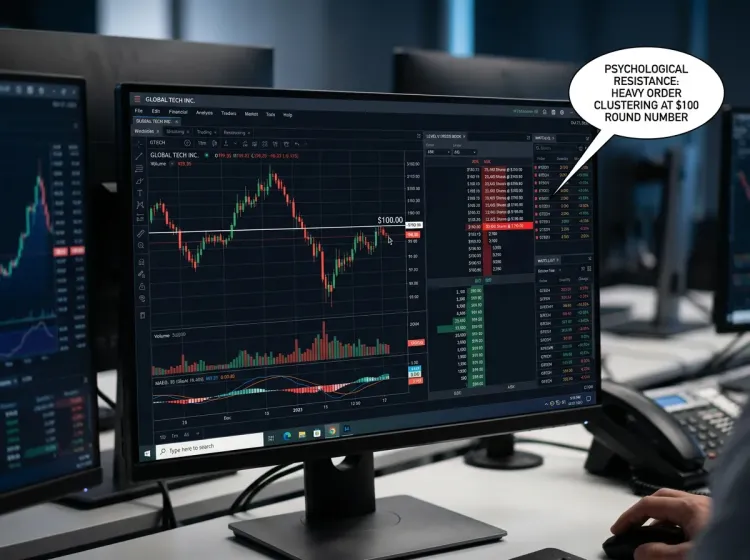
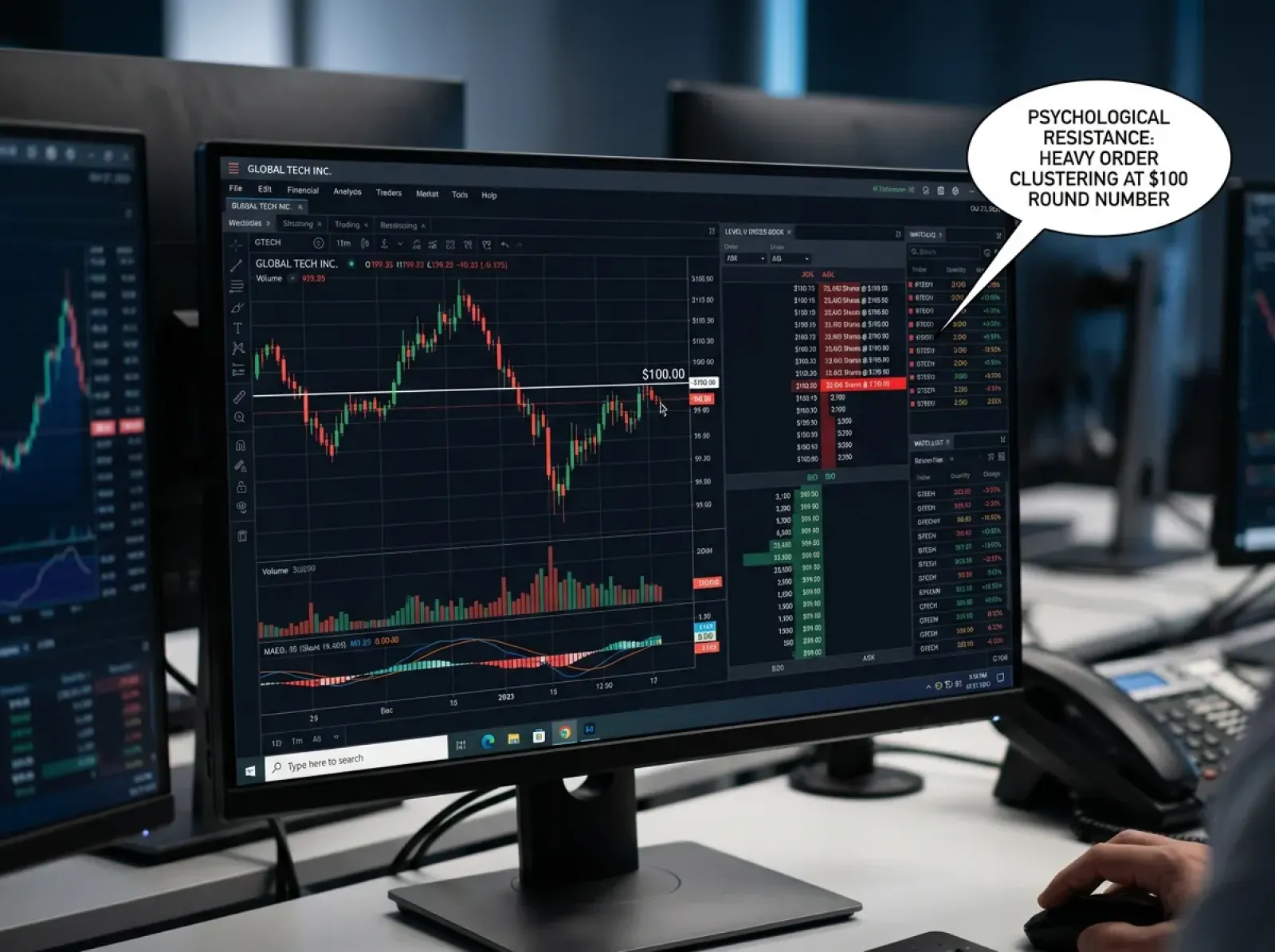
Round numbers exert a peculiar psychological gravity in trading that has nothing to do with fundamental value. There's no mathematical reason why $100 should be more significant than $99.73 or $101.28, yet traders consistently treat round numbers as meaningful thresholds. This isn't entirely irrational—because so many traders anchor to round numbers, these levels often do see increased activity, creating a self-fulfilling dynamic. But understanding why round numbers attract attention helps you distinguish between genuine technical significance and pure psychological anchoring bias that distorts your decision-making.
Why round numbers attract disproportionate attention:
-
Human brains prefer round numbers because they're easier to process and remember
-
Round numbers feel like natural stopping points or targets
-
Financial media emphasizes round number crossings as newsworthy events
-
Order clustering at round numbers creates actual support and resistance effects
-
Options strike prices often occur at round numbers, concentrating activity at those levels
-
Round numbers serve as easy reference points in conversation and analysis
-
Price targets gravitate toward round numbers even when precision would suggest different levels
-
Stop losses and profit targets cluster at round numbers because traders default to them
The Self-Fulfilling Nature of Round Number Effects
Round numbers create a feedback loop where collective anchoring bias produces real market effects that seem to justify the anchoring.
When enough traders anchor to $100 as a significant level, they place buy orders just below it, sell orders just above it, and stop losses at or near it. This order clustering creates genuine supply and demand dynamics at the round number that wouldn't exist otherwise. Price may bounce off $100 or struggle to break through it—not because of any fundamental reason, but because so many traders have anchored to that level and acted on their anchoring. This self-fulfilling prophecy makes round number effects partially real while remaining fundamentally arbitrary. The level matters because traders think it matters, not because of anything intrinsic to that price.
When Round Number Awareness Is Useful vs. Harmful
Understanding round number dynamics can help your trading, but only if you don't fall into the same anchoring trap you're trying to exploit.
When round number awareness helps:
-
Anticipating order clustering and potential support or resistance at major round numbers
-
Avoiding placing stops exactly at obvious round number levels where they may be targeted
-
Understanding why price might hesitate or accelerate around certain thresholds
-
Recognizing when media coverage of round number crossings might create short-term volatility
When round number anchoring bias hurts:
-
Setting profit targets at round numbers simply because they feel like good places to exit
-
Assuming a stock that reaches $100 is significantly different than one at $98
-
Waiting to buy until a stock drops to a round number rather than acting on your analysis
-
Treating round number crossings as meaningful signals rather than psychological phenomena
-
Placing stops at round numbers where order clustering makes them more likely to be triggered
-
Letting round numbers substitute for proper analysis of support, resistance, and fair value
Remember: Round number anchoring bias operates both individually and collectively, creating market effects that feel technical but are actually psychological—awareness of this dynamic helps you anticipate how others will behave while avoiding the trap of treating arbitrary round numbers as inherently meaningful in your own analysis.
The Real-World Cost of Anchoring Bias


Anchoring bias isn't just an interesting psychological phenomenon—it translates directly into damaged trading results. The costs accumulate quietly, trade by trade, as anchored thinking leads to suboptimal decisions that compound over time. Most traders never calculate the full damage because the counterfactual—what would have happened without the bias—is invisible. But the patterns are predictable: losers held too long, winners cut too short, opportunities missed because expectations were anchored to irrelevant reference points.
The real-world costs of anchoring bias in trading:
-
Holding losing positions waiting to get back to even, allowing small losses to become large ones as the original thesis deteriorates
-
Watching positions decline further while anchored to entry prices that the market has already deemed irrelevant
-
Cutting winning positions too early because gains from entry feel sufficient, missing the larger moves that drive portfolio returns
-
Selling at arbitrary percentage gains like 20% or 50% rather than when price action suggests exiting
-
Missing buying opportunities because stocks seem expensive relative to historical prices that no longer reflect current value
-
Passing on strong performers because they've already moved and feel like missed opportunities rather than ongoing trends
-
Setting price targets based on prior highs, analyst targets, or round numbers rather than current analysis
-
Avoiding stocks at all-time highs when those stocks often continue performing well
-
Averaging down into deteriorating positions because each new lower price looks cheap relative to earlier purchases
-
Over-concentrating in beaten-down names that feel like bargains but continue declining
-
Under-allocating to winners that feel extended but remain in strong uptrends
-
Making position sizing decisions based on past price levels rather than current risk assessment
-
Experiencing portfolio drift as anchored decisions accumulate into unintended allocations
Portfolio-Level Damage Over Time
Individual anchoring errors might seem minor, but their cumulative effect can devastate long-term portfolio performance.
Each trade affected by anchoring bias contributes to a pattern where you systematically exit your best positions too early and hold your worst positions too long—the exact opposite of what profitable trading requires. Over hundreds of trades, this pattern compounds into dramatically reduced returns compared to what the same opportunities would have produced with unbiased decision-making. Research on investor behavior consistently shows that individual investors underperform the very funds they invest in because of poorly timed entries and exits driven by psychological biases including anchoring. The costs aren't visible in any single trade, but they're devastatingly real when measured across a trading career.
Recognizing Anchoring in Your Own Trading


The first step toward reducing anchoring bias is recognizing when it's operating in your own decisions. This is harder than it sounds because anchoring feels like rational analysis rather than bias. When you think "this stock is cheap because it used to trade at $150," you experience that as a logical observation, not as psychological distortion. Developing the ability to catch yourself mid-anchor requires deliberate practice, self-observation, and honest reflection on why you're making the decisions you make.
Journaling to Identify Anchor Points
A trading journal that captures your reasoning at the moment of decision creates a record you can review for anchoring patterns.
What to track in your journal for anchoring awareness:
-
The specific reference points you're using to justify buy or sell decisions
-
Any historical prices, analyst targets, or round numbers you mention in your reasoning
-
Your entry price and whether it appears in your exit rationale
-
The phrases you use to describe value, opportunity, or risk
-
Your expectations for price movement and where those expectations come from
-
Any comparisons to past prices, past performance, or external opinions
-
How you felt about the decision and what made it feel right
Questions to Ask Before Trading Decisions
Structured self-questioning can interrupt automatic anchoring bias before it drives your decisions.
Questions that reveal anchoring:
-
Would I buy this stock at current prices if I didn't already own it?
-
Am I holding because the thesis remains valid or because I don't want to take a loss?
-
What reference point am I using to judge whether this price is attractive?
-
If I delete the chart history and look only at current price, does my analysis change?
-
Am I waiting for a specific price level, and why is that level significant?
-
Where did my price target come from—my analysis or an external source?
-
Is this stock actually cheap, or does it just look cheap compared to where it used to trade?
-
Would I make this same decision if I had never seen the prior price history?
Common Phrases That Reveal Anchoring
Certain language patterns signal that anchoring bias is driving your thinking, even when you don't realize it.
Pay attention when you catch yourself thinking or saying phrases like "it used to trade at," "once it gets back to," "it's down so much already," "I just need it to get back to even," "it's cheap here compared to," "the analyst target is," or "it broke through a big round number." These formulations all reference anchor points that may be irrelevant to current value. The language of anchoring often includes comparisons to historical prices, external targets, or arbitrary levels that feel significant but lack analytical foundation.
Building Awareness Without Paralysis
The goal isn't to eliminate all reference points from your thinking—that's impossible—but to distinguish between useful information and arbitrary anchors.
Some reference points carry genuine analytical value. A prior support level where significant volume traded may represent real supply and demand dynamics. Current price relative to recent earnings or cash flow connects to fundamental value. But your entry price, an analyst's round-number target, or a stock's 52-week high usually don't contain useful forward-looking information. The skill is learning to question your reference points rather than accepting them automatically. This doesn't mean agonizing over every decision—it means building the habit of asking "why does this number feel significant?" and accepting "because it's anchoring my thinking" as a possible answer.
Keep In Mind: Recognizing anchoring bias in your own trading requires deliberate self-observation through journaling, structured questioning before decisions, and attention to language patterns that reveal reference point fixation—not to eliminate all anchors, which is impossible, but to distinguish between analytically useful information and arbitrary psychological anchors that distort your judgment.
Strategies to Overcome Anchoring Bias


Knowing that anchoring bias exists doesn't automatically protect you from it—the bias operates below conscious awareness and persists even when you're actively trying to counteract it. Effective strategies don't rely on willpower or vigilance alone. Instead, they create structures, rules, and processes that reduce anchor exposure or override anchored thinking before it affects decisions. The goal is building systems that produce good decisions even when your intuitive judgment is being distorted by irrelevant reference points.
Strategies for reducing anchoring bias impact:
-
Establish systematic entry and exit rules that execute based on defined criteria rather than subjective judgment
-
Use trailing stops that adjust based on price action rather than fixed targets anchored to entry
-
Define position sizing based on volatility and risk metrics rather than how the current price compares to historical levels
-
Make decisions based on what price is doing now, not what it did before or where it used to be
-
Analyze multiple timeframes to break fixation on any single reference point
-
Write down your trading plan before looking at current prices to prevent immediate anchoring
-
Hide entry prices from your portfolio display if possible to reduce their psychological salience
-
Pre-commit to exit criteria before entering trades, removing in-the-moment anchor-influenced decisions
-
Use checklists that force consideration of factors beyond anchor-influenced thinking
-
Seek out disconfirming information that challenges whatever anchor you notice yourself using
Using Systematic Rules to Override Anchors
Rules-based trading creates decision frameworks that execute regardless of how you feel about reference points.
DO establish clear, objective criteria for entries that don't depend on comparisons to historical prices.
DO define exit rules based on price action, technical levels, or time—not on distance from entry or round number targets.
DO create position sizing formulas that calculate risk based on volatility and stop distance rather than how cheap a stock feels.
DO write your rules down and commit to following them even when anchored intuition suggests otherwise.
DO backtest your rules to build confidence that they work, making it easier to follow them when anchors pull you elsewhere.
DON'T make rules so flexible that anchored judgment can override them through interpretation.
DON'T abandon systematic rules because they triggered an exit or kept you out of a trade that your anchored thinking preferred.
DON'T create rules based on historical price levels, round numbers, or other arbitrary anchors dressed up as systematic criteria.
DON'T rely on rules alone without understanding why anchoring bias makes them necessary.
Pre-Commitment and Multiple Timeframe Analysis
Pre-commitment removes decision-making from the moment when anchors are most influential, while multiple timeframe analysis dilutes the power of any single reference point.
IF you establish your exit criteria before entering a trade… THEN anchoring bias at the exit decision point has less power because the decision was already made when anchors weren't present.
IF you analyze a stock across daily, weekly, and monthly timeframes… THEN no single price level dominates your perception since different reference points appear significant at different timeframes.
IF you write down your thesis and target before looking at the current price… THEN your thinking develops independent of the immediate anchor the current price would create.
IF you review past trades specifically looking for anchoring patterns… THEN you build awareness of your personal anchoring tendencies that can inform future pre-commitments.
IF you commit to exit criteria publicly or with an accountability partner… THEN social pressure reinforces the pre-commitment against anchor-influenced deviation.
IF you set alerts at your planned exit levels rather than watching the screen… THEN you remove continuous exposure to price action that strengthens anchor effects.
Think of it this way: Anchoring bias is like a current that pushes your decisions in directions you didn't choose—systematic rules and pre-commitments are like building a boat with a keel, allowing you to move in your intended direction despite the invisible forces trying to pull you off course.
When Anchoring Can Be Useful


Not all reference points are arbitrary anchors that distort your judgment. Some historical prices carry genuine analytical value because they represent levels where actual market behavior occurred—not just psychological fixation, but real supply and demand dynamics that may persist. The challenge is distinguishing between legitimate technical information and pure anchoring bias, recognizing that even useful reference points can become harmful anchors if you treat them with unwarranted certainty.
When reference points carry genuine analytical value:
-
Prior support levels where significant buying volume halted declines, suggesting real demand at those prices
-
Prior resistance levels where significant selling volume stopped advances, suggesting real supply at those prices
-
Volume-weighted average price (VWAP), which represents the actual average price where transactions occurred
-
High volume nodes on volume profile analysis, showing price levels where substantial trading activity concentrated
-
Gap fills that represent genuine inefficiencies in price discovery rather than arbitrary targets
-
Pivot points calculated from actual price action rather than imposed from external sources
-
Moving averages that reflect actual trading history weighted by time
-
Price levels where institutional buying or selling is documented through filings or volume analysis
Distinguishing Technical Levels from Psychological Anchors
The difference between a useful technical level and a harmful anchor lies in whether the reference point contains actual market information or just psychological significance.
Legitimate support and resistance levels work because they represent prices where buyers or sellers previously stepped in with enough force to reverse price direction. If significant volume traded at $85 and price bounced there multiple times, that level contains real information about where demand exists. This differs fundamentally from anchoring to $85 simply because it's a round number or because it's where you bought the stock. Volume-weighted reference points like VWAP matter because they reflect actual transaction history, not arbitrary fixation. The key question is whether the reference point emerged from market behavior or from psychological tendency. A prior high where no unusual volume occurred and no reversal happened is just a number on a chart. A prior high that marked a multi-week battle with clear volume signatures and multiple failed breakouts contains genuine information worth considering. Understanding this distinction lets you use historical price information appropriately while avoiding pure anchoring bias.
Using Awareness of Others' Anchoring
Once you understand anchoring bias, you can anticipate how it affects other market participants and potentially use their predictable behavior to your advantage.
Many traders anchor to the same reference points—recent highs and lows, round numbers, widely publicized analyst targets, 52-week extremes. This collective anchoring creates order clustering and predictable behavior patterns around these levels. Knowing that stops cluster at obvious levels helps you place your own stops less obviously. Knowing that round numbers attract attention helps you anticipate reactions when price approaches them. Understanding that beaten-down stocks attract value-seeking anchored buyers helps you anticipate where buying interest might appear. You're not exploiting anchoring bias so much as acknowledging its reality and incorporating others' predictable behavior into your analysis. Just be careful not to become anchored yourself while trying to exploit anchoring in others—the bias doesn't spare those who think they've outsmarted it.
Living With Anchoring Bias


Anchoring bias isn't a bug you can patch or a bad habit you can break—it's a fundamental feature of how human cognition operates. The brain uses reference points because absolute evaluation is cognitively expensive and reference-based comparison is fast and efficient. This served our ancestors well in environments where quick decisions mattered more than perfectly calibrated ones. But in trading, where irrelevant reference points constantly present themselves and biased decisions compound into damaged returns, this cognitive shortcut works against you. Accepting that anchoring will never disappear entirely is the first step toward managing it effectively.
Progress Through Awareness and Systems
You won't eliminate anchoring bias, but you can reduce its damage through continuous awareness, systematic rules, and structures that override anchored intuition.
Progress means noticing when you're anchored, questioning whether the reference point contains genuine information, and having systems in place that produce good decisions even when your judgment is compromised. Progress means your trading journal reveals fewer anchor-driven mistakes over time—not zero, but fewer. Progress means catching yourself mid-sentence when you say "it used to trade at" and asking whether that historical price actually matters. Progress means following your pre-committed exit rules even when anchored thinking screams that you should wait for a better price. The goal isn't a mind free of anchoring bias—that's impossible. The goal is a trading process robust enough to function well despite operating inside a biased mind that will never be fully objective. Every trader carries these cognitive limitations. The ones who succeed are those who acknowledge this reality and build their approach around it rather than pretending they've somehow transcended the psychology that affects everyone else.
