

Trading attracts myths the way a chart attracts trend lines. Everyone hears them, most people repeat them, and a surprising number build their entire approach around them. The result? Confusion, frustration, and plenty of unnecessary losses.
So here’s a reality check. Not the usual recycled clichés, but the myths that actually trip traders up. The ones that quietly shape your decisions without you even noticing. Whether you’re a couple of months in or somewhere in that messy middle stage of “I sort of know what I’m doing… I think?”, this breakdown should save you a few headaches and maybe a few dollars too.
Myth 1: “If I find the right strategy, everything else will fall into place.”

Reality
Most strategies can work but can be very dependent on specific market conditions.
New traders hunt endlessly for “the one” system. They switch indicators, timeframes, markets. The problem is not usually the setup. It is position sizing, execution quality, emotional control, and the ability to stick to a simple playbook long enough to build real data.
Practical takeaway
Pick 1–3 core setups. Trade them small. Track them for at least 50–100 trades before judging. Journal entries, exits, emotions, and context. Improve the trader operating the strategy, not just the strategy itself.
Myth 2: “Real traders trust their gut.”
Reality
“Gut feel” is just pattern recognition built from data and reps. Without that foundation, your gut is just anxiety in a different outfit.
Experienced traders might say, “It did not feel right.” What they really mean is that subtle context did not match their historical experience. A news narrative or confluence of other non-TA factors can give you a stronger gut feeling, but mastering this sixth sense takes many years of trading under your belt. New traders try to copy that, but they do not have the reps yet, so their gut is mostly fear, greed, or boredom.
Practical takeaway
If you have less than a few years of consistent trading, treat your gut as a signal to slow down, not act. Let rules and checklists lead. Instinct becomes useful once you have thousands of screened charts behind it.
Myth 3: “High win rate equals a good trader.”
Reality
You can win 80 percent of trades and still be a bad trader if your losers are huge and your winners are tiny.
Many beginners obsess over being “right”. They cut winners early to protect their ego and let losers run because closing them would confirm they were wrong. Professionals focus on expectancy: win rate combined with average reward to risk across a large sample.
Practical takeaway
Track two numbers.
- Win rate.
- Average R per trade, how much you made or lost compared to your risk.
A trader with a 45 percent win rate and average +1.5R can outperform a 75 percent win rate trader who averages +0.3R and occasionally takes a –5R meltdown.
Myth 4: “Real traders are all-in, all the time.”

Reality
Most long-term surviving traders are underexposed more often than they are overexposed.
Social media shows the leverage screenshots and 100 percent account days. It does not show the people quietly compounding 0.3–1 percent a day and staying in the game for decades. Consistency comes from controlling how often you take risk, not constantly maxing out.
Practical takeaway
- When you are allowed to size up.
- When you must size down.
- When you must sit in cash.
Treat cash as a position, not a failure.
Myth 5: “If my analysis is strong, I do not need hard stops.”
Reality
Your analysis is at its most convincing right before you are wrong.
Markets can gap, trend beyond reason, or ignore your edge for long periods. Pros assume they will be wrong often. That is why they place hard exits, use position sizing, and cap daily loss. Overconfidence in analysis is one of the main roads to account blow-ups.
Practical takeaway
- Place your stop as soon as you enter.
- Position size so that hit does not bother you emotionally.
- Never move a stop further away. Only closer or to break even as the trade works.
Myth 6: “Small accounts need to swing for the fences.”
Reality
Small accounts cannot afford big emotional damage. One huge loss teaches all the wrong lessons and usually leads to revenge trading.
The idea that you “have” to take oversized risk because your account is small is just a justification for gambling. The math of compounding does not care how you feel about your current balance, only about your percentage returns and your ability to survive long enough.
Practical takeaway
Aim for clean execution and consistent percentage gains, not home runs. Use small fixed risk per trade. Focus on learning how to not blow up. Once you can protect a small account, scaling size becomes much easier.
Myth 7: “Backtesting results will translate directly into live trading.”
Reality
Backtests do not include your heartbeat.
You can test a system and get beautiful equity curves. Then you trade it live and start skipping signals, overriding exits, or cherry-picking trades. Slippage, spreads, partial fills, and your own psychology all change the real-world outcome.
Practical takeaway
Treat backtesting as the first filter. Then run a forward test in a simulator or with tiny size. Journal every deviation from the rules. Often the system is fine. It is your ability to follow it in real time that needs adjustment.
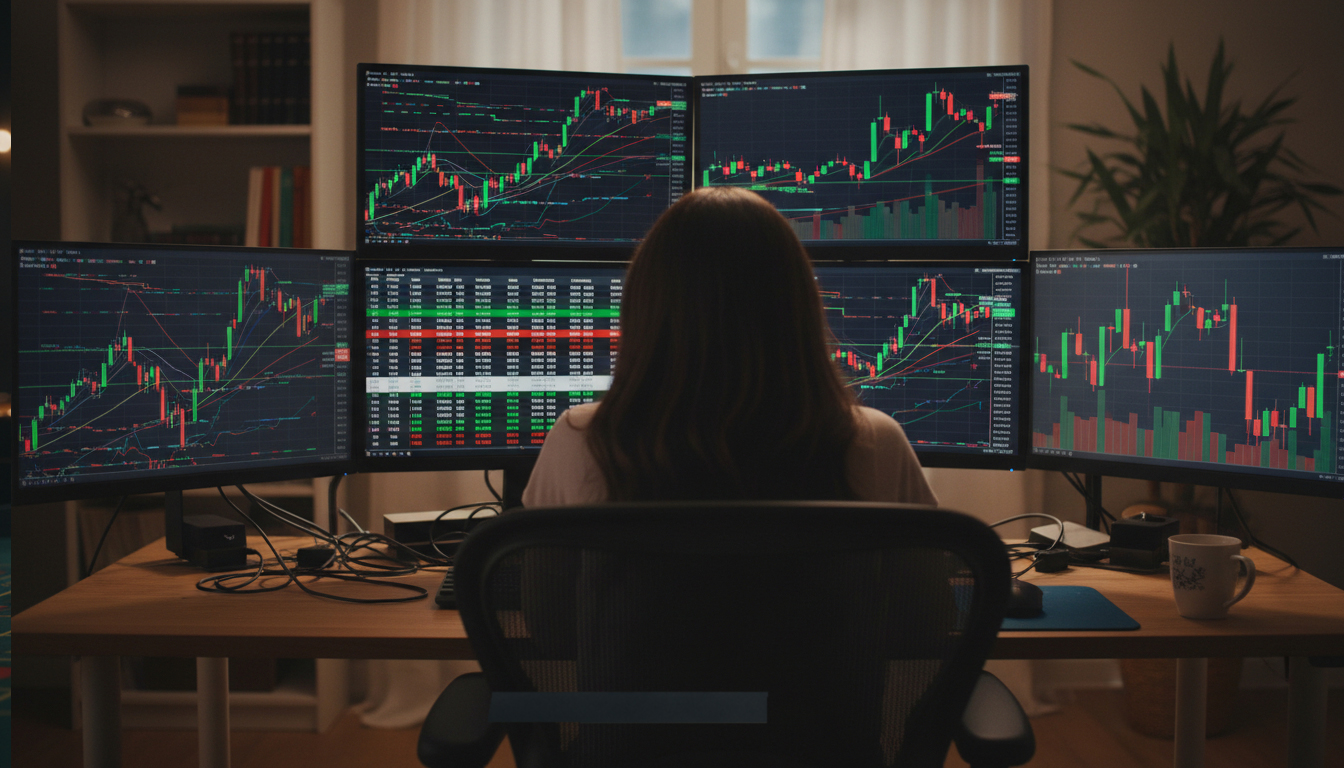
Myth 8: “More screens, more indicators, more data equals better trading.”
Reality
Information without structure just creates more ways to doubt your plan.
New traders often upgrade gear and pile on indicators when they feel lost. The result is analysis paralysis. Entries come late, exits get messy, and every loss sends them back to tweaking the system.
Practical takeaway
Simplify until you can explain your entire process to a 12-year-old.
For example, “I trade only these three tickers. I use these two timeframes. I enter on this pattern with this stop and this target.”
Once that is consistent, then consider adding one more input at a time.
Myth 9: “Once I fix my psychology, I will stop feeling emotions in trades.”
Reality
Emotions never leave. You just stop giving them the steering wheel.
Good psychology work does not make you Zen and emotionless. It helps you recognise what you are feeling and stick to your rules anyway. Pros still feel fear and greed. They simply have systems that limit the damage when those emotions flare.
Practical takeaway
Shift your goal from “I want to feel calm in every trade” to “I want rules that still work even when I am not calm.”
Examples include mandatory breaks after two losses, daily max loss, pre-trade checklists, no adding to losers, and post-trade review based on process rather than PnL.
Myth 10: “I only need to focus on my favourite timeframe.”

Reality
You can absolutely trade one timeframe, but you cannot understand the market from just one.
A common trap for newer traders is locking into the 5m, 15m, or 1H chart and ignoring everything above it. The problem is that your perfect-looking setup can fail instantly because a higher timeframe is doing something completely different.
You short the break of 15m resistance expecting momentum. It immediately stalls because the 4H chart is simply forming a higher low, and your breakdown is nothing more than a minor dip inside a healthy uptrend.
Multiple timeframe analysis is not about overcomplicating things. It is about avoiding classic mistakes like trading against trend structure you did not even see.
Practical takeaway
Trade your chosen timeframe, but always check the trend, structure, and key levels above it. Higher timeframes set the weather you are trading in. Your job is to align your entries with that backdrop, not fight it.
Chart Guys Joey explains multiple time frame analysis in great depth in this webinar >
In Summary
Markets are great at humbling anyone who hangs onto a bad myth. You do not need magic indicators, just clear thinking and a toolkit grounded in reality. Revisit these myth checks as you grow. And if you fall for one again, you are human. Noticing it sooner is the real progress.
