Falling Wedge (in Uptrend)

Bullish Continuation Pattern
A pullback narrows as urgency fades. This is where patient buyers outlast anxious sellers. Spot the turn, trust the break, and ride the next step of the trend without forcing entries.
Tobi Frenzen
Author
Tobi Frenzen
Published
August 13, 2025
Author
Tobi Frenzen
Published
Aug 13, 2025
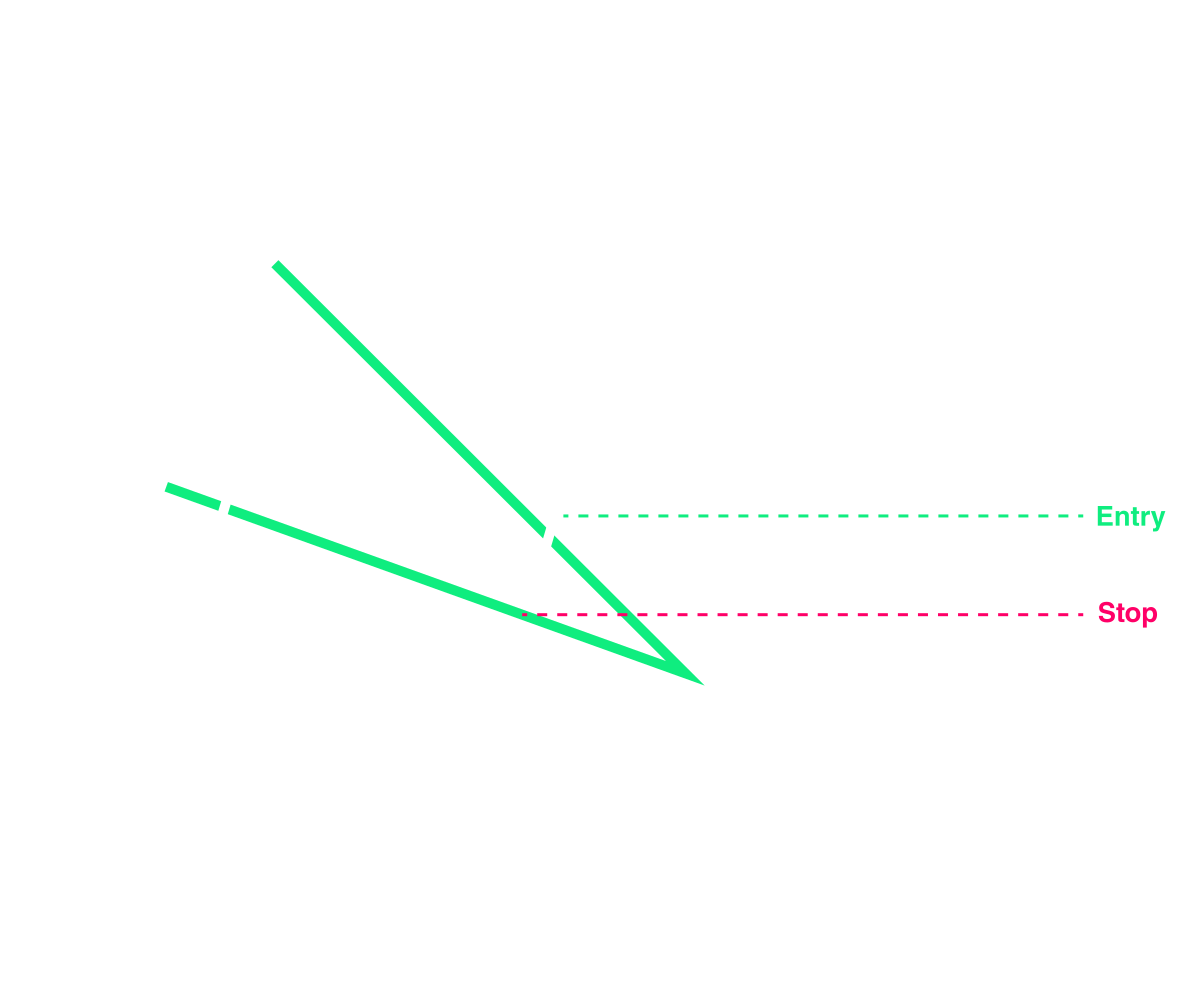
Falling Wedge (in Uptrend) Schematic - Bullish Continuation Pattern
Falling Wedge (in Uptrend) Schematic - Detail View
Falling Wedge (in Uptrend)
Bullish Continuation Pattern

Pattern Schematic

Falling Wedge (in Uptrend)

Pattern Bias

Bullish

Pattern Type

Continuation

Consolidation

Yes

Typically Breaks

Up

Characteristics

Converging pullback against trend.

Description

Price pulls back in a narrowing, downward-sloping range as momentum wanes against the dominant uptrend; upside break resumes trend.

Reliability

Higher odds with diminishing volume and bullish momentum divergence.

Invalidation

Failure back into wedge or making a lower low beyond wedge start.

Entry

Close above upper wedge line or breakout + retest entry.

Stop

Below recent swing low or below lower wedge line.

Target

Measure back to start of wedge or add wedge height at breakout.

Definition & Identification

Falling Wedge (in Uptrend)

A Falling Wedge in an uptrend is a bullish continuation pattern. It represents a controlled pullback during a larger advance. Key elements:

  • Downward-sloping converging trendlines containing price.
  • Lower highs and lower lows, but with diminishing downward energy.
  • Volume often contracts.
  • The breakout is usually upward, resuming the uptrend.

Pattern Psychology

Falling Wedge (in Uptrend)

This wedge signals healthy consolidation within an uptrend:

  • Bulls take profit, producing a pullback.
  • Bears press lower, but each push lacks strength.
  • Buyers absorb supply, waiting for confirmation of breakout.
  • Once resistance breaks, bulls resume control, often driving a strong continuation rally.

Reliability Stats

Falling Wedge (in Uptrend)

Bulkowski’s falling wedge data applies here:

  • Upward break frequency: ~68%.
  • Failure rate: ~11%.
  • Average rise: ~38%.
  • Throwback frequency: ~60%.

Continuation contexts tend to unfold more smoothly since the wedge resolves in the direction of the dominant trend.

Trade Plan

Falling Wedge (in Uptrend)

Entry: Go long when price breaks above wedge resistance.

Stop loss: Below wedge support or last swing low.

Targets: Minimum = wedge height projected upward. Additional = prior highs or measured move extensions.

Invalidation: If price breaks below wedge support and fails to recover, the continuation fails.

Nuances & Common Traps

Falling Wedge (in Uptrend)
  • False downside breaks: Sometimes price dips below support briefly before surging upward.
  • Late-apex problem: Breakouts near the wedge tip tend to stall.
  • Volume: A breakout accompanied by strong volume has higher odds of sustained follow-through.
  • Trend maturity: If the larger uptrend is already extended, the wedge may signal topping instead of continuation.

When to Skip

Falling Wedge (in Uptrend)
  • If the wedge forms late in a parabolic bull run, where exhaustion risk outweighs continuation odds.
  • If broader market conditions are bearish, overriding the local pattern.
  • If the wedge looks more like a broad descending channel than a converging formation.
Falling Wedge (in Uptrend) Summary
Falling Wedge (in Uptrend)

Summary

The Falling Wedge in an uptrend is a bullish continuation setup. Breaking upward ~68% of the time with ~38% average gains, it reflects controlled pullback before resumption of the dominant trend. Context and trend maturity should be considered to avoid mistaking exhaustion for consolidation.

Join The
Chart Guys!

To learn from other experienced traders and technical analysts, why not join our unique trading community? We can't wait to welcome you in our trading room to answer your questions and help you achieve your goals.
Follow Us On Social Media